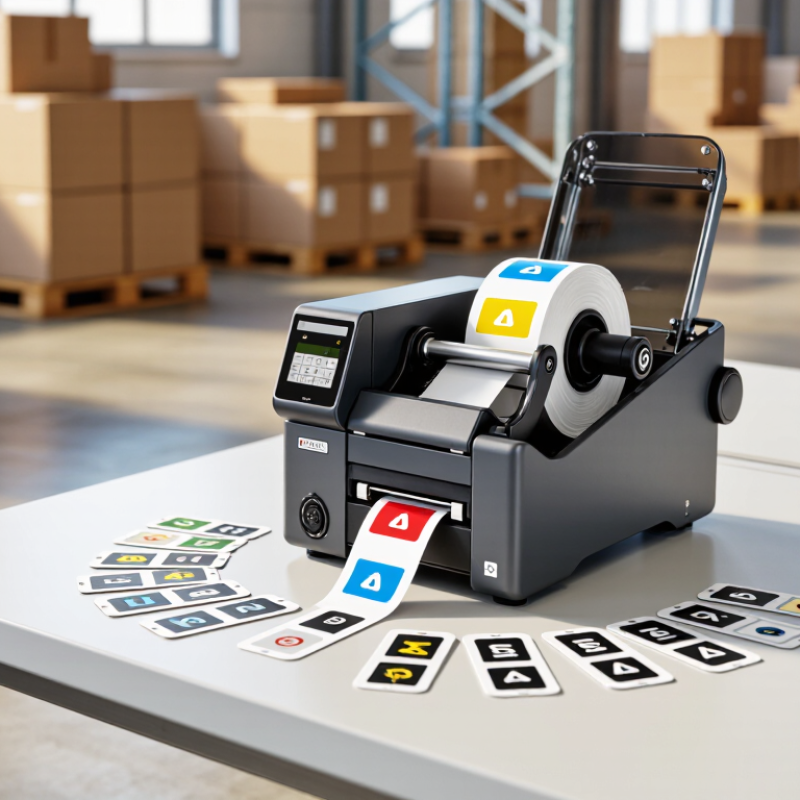
| Core Function | Prints visible information such as text, barcodes, and graphics while encoding digital data to an RFID inlay embedded in a label or tag. | Combines label printing and electronic identification in one workflow, reducing the need for separate encoding equipment. | Print + Encode |
| Identification Method | Uses radio communication between the printer's RFID reader and the tag chip. The printer can also verify whether the tag was encoded successfully. | Supports automated data capture and helps reduce manual scanning and data-entry errors. | Contactless |
| Common RFID Frequency | UHF RFID commonly operates in the 860–960 MHz range, with the exact permitted range depending on regional regulations. HF RFID operates at 13.56 MHz, while LF RFID commonly operates at 125–134.2 kHz. | Frequency selection can be matched to read range, material conditions, and application requirements. | Application-Dependent |
| Power Source of Typical Tags | Most supply-chain RFID labels use passive tags, which receive operating energy from the reader's radio signal and do not contain a battery. | Passive tags can be thinner, lighter, and suitable for high-volume item, carton, and pallet identification. | Usually Passive |
| Visible Label Content | Thermal transfer or direct thermal printing can place human-readable text, serial numbers, logos, and one-dimensional or two-dimensional barcodes on the label. | Employees can use visual information or barcode scanning when RFID reading is unavailable or unsuitable. | Human + Machine Readable |
| Electronic Data | Depending on the tag type, the printer may encode an electronic product identifier, serial number, asset number, batch reference, or other application data. | Creates a digital identity that can be linked to inventory, shipping, receiving, and traceability records. | Unique Identity |
| Typical Print Resolutions | RFID-capable thermal printers are commonly available in 203, 300, or 600 dots per inch. The appropriate resolution depends on label size, barcode density, and required image detail. | Allows businesses to select a balance between print detail, label format, and equipment cost. | 203–600 dpi |
| Data Accuracy | Many RFID printer workflows include tag-read verification after encoding. Failed or unreadable inlays can be rejected before the label is applied. | Helps prevent unusable tags from entering inventory or shipping processes. | Verify Before Use |
| Material Considerations | Metal and liquids can affect UHF RFID performance. Specialized tag designs, suitable inlay placement, and application testing may be required for these materials. | Improves read reliability in challenging environments such as metal containers, liquid products, and industrial assets. | Test Required |
| System Integration | Printer workflows can receive variable data from warehouse, inventory, manufacturing, shipping, or enterprise software through compatible interfaces and print commands. | Supports automated label creation and reduces duplicate data entry across operational systems. | Workflow Ready |
| Readability Advantage | RFID readers can identify tags without requiring direct line of sight, subject to tag orientation, reader configuration, surroundings, and operating frequency. | Enables faster identification of multiple tagged items compared with scanning each barcode individually. | No Direct Line of Sight |
| Recommended Evaluation Criteria | Before deployment, evaluate tag compatibility, required read distance, label material, printer throughput, encoding reliability, software integration, and total operating cost. | Helps ensure that the selected RFID printer fits the real business process rather than only the printing requirement. | Pilot First |



 Close
Close