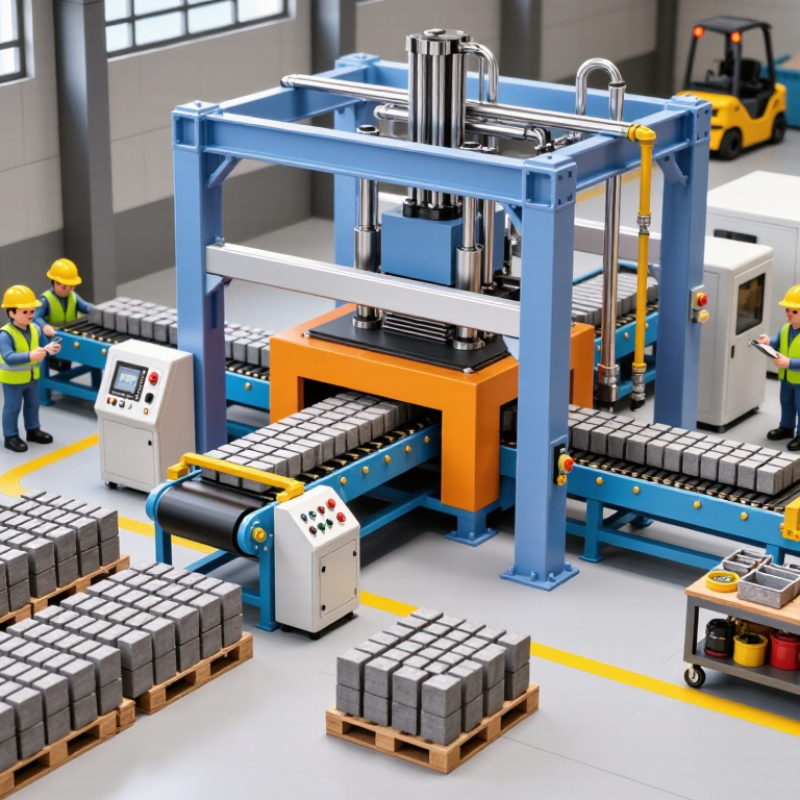
A block forming machine is industrial equipment that converts measured concrete into uniform masonry units.
Its core cycle includes batching, mixing, feeding, vibration, compression, and demolding. The mold controls each block’s dimensions and surface profile. Vibration reduces trapped air, while pressure stabilizes the fresh unit. Operators can produce hollow blocks, solid blocks, paving units, or customized shapes by changing molds.
The machine is not simply a concrete mixer. It is a forming system that improves repeatability after mixing.
A machine’s business value depends on cycle time, mold-change speed, compaction quality, and curing arrangements.
Production claims need caution. Actual output changes with block size, concrete moisture, operator skill, and downtime. During plant testing, measure acceptable blocks per hour, not only advertised capacity.
The United Nations Environment Programme reported in its 2023 Global Status Report that buildings and construction consumed 34% of global energy and generated 37% of energy- and process-related emissions.
This report does not measure block machines directly, but it shows why efficient batching and lower rejection rates matter.
Tips:
Request a sample run with local aggregates. Record moisture, cycle time, rejection rate, power use, and mold-change minutes. Check compressive strength against the applicable standard, such as ASTM C90 where relevant. Leave room for error. Real plants are rarely perfectly balanced. A machine may look efficient until curing space, maintenance delays, and inconsistent raw materials expose the gaps.



 Close
Close