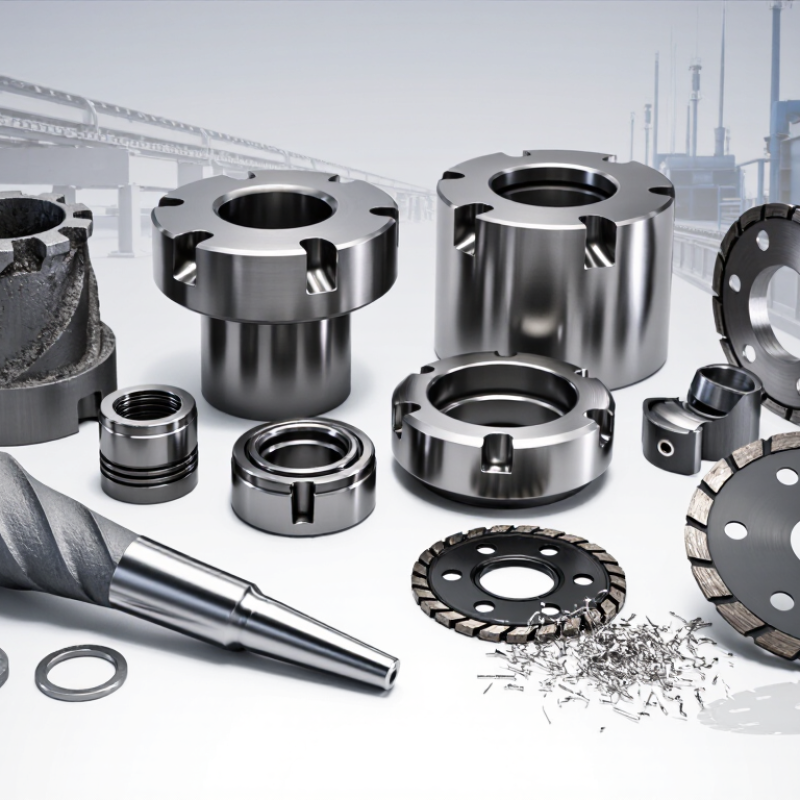
| Material composition | Tungsten carbide, commonly represented as WC, is a hard ceramic compound made from tungsten and carbon. Engineering grades are often cemented with a metallic binder such as cobalt or nickel. | The combination of a very hard ceramic phase and a tougher binder provides a useful balance of wear resistance and mechanical strength. | Properties vary significantly with carbide grain size, binder content, porosity, and manufacturing method. |
| Hardness | Cemented tungsten carbide commonly reaches approximately 1,300–2,200 HV, depending on grade and binder content. | High hardness helps resist abrasion, scratching, deformation, and cutting-edge wear. | Increasing hardness generally reduces toughness, making the material more sensitive to impact and edge chipping. |
| Density | Typical cemented tungsten carbide density is approximately 14.0–15.5 g/cm³, while nearly pure WC is about 15.6 g/cm³. | The high density can provide inertia, stability, and resistance to vibration in selected components. | It is substantially heavier than steel, aluminum, and most oxide ceramics, which may increase handling and structural loads. |
| Compressive strength | Typical cemented carbide grades can withstand compressive stresses of roughly 4–7 GPa, depending on composition and test method. | It performs well in dies, punches, anvils, and wear parts exposed mainly to compressive loading. | Tensile, bending, and impact loading must be carefully controlled because ceramic materials are less tolerant of flaws and stress concentrations. |
| Fracture toughness | Typical cemented carbide fracture toughness is approximately 6–20 MPa·m1/2, with tougher grades generally having more binder and coarser carbide grains. | Properly selected grades can tolerate moderate mechanical shocks better than many monolithic ceramics. | It remains more brittle than most steels and can fail suddenly if chipped, cracked, or improperly supported. |
| Wear resistance | Excellent against abrasive, sliding, and erosive wear when the grade, surface finish, and operating conditions are properly matched. | Longer service life and more consistent dimensions in high-wear components. | Adhesive wear, corrosion, thermal shock, or impact can still cause premature damage. |
| Cutting and machining tools | Used for inserts, milling cutters, drill bits, turning tools, mining tools, and woodworking blades. | Maintains a hard cutting edge at elevated temperatures and supports high production rates. | It may chip under interrupted cuts, severe vibration, or incorrect cutting conditions. |
| Wear components | Used for nozzles, bushings, seals, bearings, valve parts, guide components, slurry-handling parts, and forming dies. | Low wear rates can improve dimensional stability and reduce maintenance frequency. | The component may require a steel housing, brazed joint, shrink fit, or other support to manage brittleness. |
| Oil and gas applications | Used in selected downhole wear parts, flow-control components, drilling elements, and erosion-resistant parts. | Resists abrasive particles and high contact stresses in demanding service environments. | Grade selection must account for corrosion, temperature, pressure, impact, and compatibility with the surrounding materials. |
| Chemical and corrosion behavior | Tungsten carbide has good resistance to many corrosive and abrasive environments, but the binder phase may corrode in certain acids, oxidizing solutions, or wet conditions. | Can provide reliable service where both wear and chemical exposure are present. | Binder chemistry, fluid composition, temperature, and electrical potential can strongly affect corrosion performance. |
| Thermal performance | WC has high thermal conductivity compared with many technical ceramics; cemented grades commonly fall around 50–110 W/m·K, depending on binder content and structure. | Heat can be transferred away from a cutting edge or contact zone relatively effectively. | Rapid temperature changes can cause thermal cracking, and high-temperature oxidation may limit unprotected use in air. |
| Manufacturing and finishing | Common processes include powder pressing, sintering, grinding, electrical discharge machining, and selected coating or joining operations. | Near-net-shape forming can reduce material waste, while diamond grinding can produce precise surfaces. | Grinding and finishing are slower and more expensive than machining many steels; specialized tooling and process control are often required. |
| Overall advantages and limitations | Key advantages include exceptional hardness, strong compressive performance, excellent wear resistance, dimensional stability, and useful thermal conductivity. | It is especially effective for high-wear, high-pressure, and precision applications where service life is more important than low weight or easy machining. | The main limitations are high density, high processing cost, brittleness, sensitivity to impact and thermal shock, and possible binder corrosion. |



 Close
Close