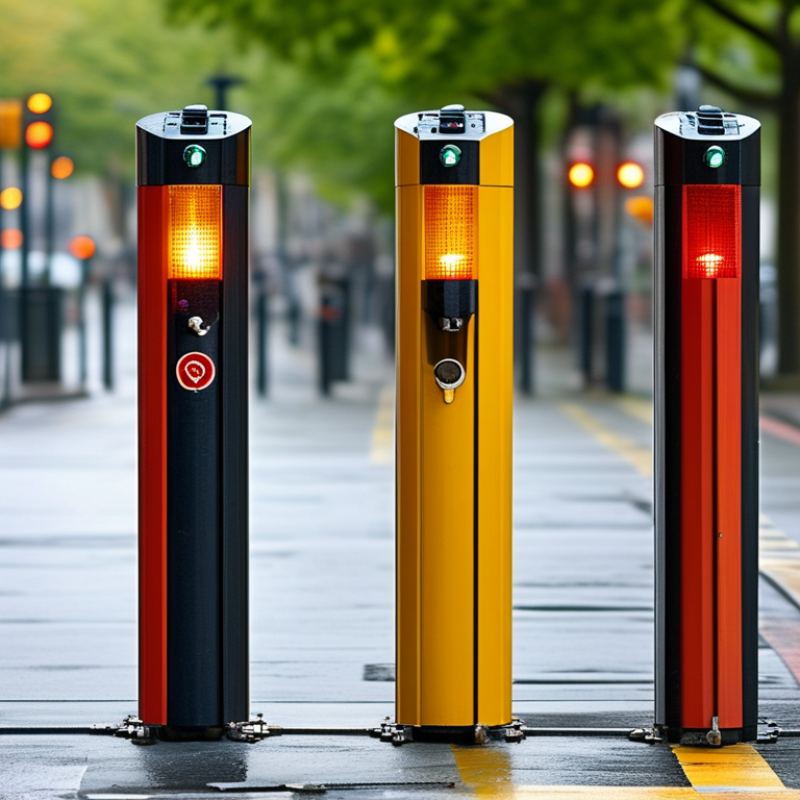
| Bollard purpose | A short, sturdy post installed vertically in the ground | Creates a physical boundary that separates pedestrian areas, buildings, roads, parking spaces, or restricted zones from vehicle routes | Traffic management, pedestrian protection, perimeter security, and parking control |
| Fixed bollard | Permanently anchored; commonly about 600–1,200 mm above ground | Always blocks vehicle passage while allowing pedestrians to move around it when spacing is properly planned | Building fronts, sidewalks, pedestrian streets, and permanent perimeter protection |
| Removable bollard | Post lifts out of a receiving socket; height is often about 600–1,000 mm | Blocks access when installed and permits authorized vehicles through after the post is removed | Temporary road closures, event spaces, service entrances, and seasonal access control |
| Retractable bollard | Retracts into an in-ground housing; visible height commonly ranges from about 500–900 mm | Raised position prevents passage; lowered position creates a vehicle opening without moving the post by hand | Controlled entrances, service roads, emergency routes, and pedestrianized areas |
| Manual locking system | Key-operated lock, padlock, locking pin, or internal latch | Keeps a removable or retractable bollard in its blocking or open position until an authorized person releases the mechanism | Low-frequency access points and sites with simple operational requirements |
| Automatic locking system | Electromechanical or hydraulic mechanism controlled by an access system | Locks the bollard after movement and can coordinate access with a card reader, keypad, remote control, intercom, or vehicle detection system | Regularly used entrances, managed parking areas, commercial sites, and secure facilities |
| Telescopic height adjustment | Multi-section post with a variable raised height; adjustment depends on the design | Allows the barrier height to be adapted to clearance needs, visibility requirements, or temporary traffic conditions | Flexible site layouts, maintenance areas, and locations with changing vehicle requirements |
| Raised height effect | A higher visible post provides a stronger visual and physical indication of restricted access | Discourages vehicles from crossing the boundary and makes the access status easier for drivers to identify | Driveways, pedestrian crossings, loading areas, and controlled lanes |
| Lowered height effect | Post is fully retracted or removed, leaving the designed vehicle clearance open | Allows authorized vehicles to pass without permanently removing the traffic-control installation | Emergency access, deliveries, waste collection, and scheduled service traffic |
| Spacing between bollards | Often planned around pedestrian and accessibility needs; approximately 1,200–1,500 mm clear spacing is commonly used, subject to local standards | Narrow spacing prevents most vehicles from passing while maintaining a usable pedestrian route | Sidewalks, entrances, shared spaces, and cycle or pedestrian routes |
| Access authorization | Key, access card, keypad code, remote transmitter, intercom approval, or automatic vehicle identification | Allows only approved users to change the bollard from its blocking position to its open position | Private driveways, managed car parks, campuses, and restricted service roads |
| Safety and visibility | Reflective bands, contrasting colors, lighting, rounded edges, and warning signs | Improves driver awareness, especially at night or in poor weather, and reduces the risk of striking the bollard | Public streets, parking areas, entrances, and locations with mixed pedestrian and vehicle movement |
| Impact-resistance level | Varies from light-duty visual guidance to engineered security-rated protection; performance depends on the complete installation | Determines whether the bollard is intended mainly to guide traffic, stop unauthorized parking, or resist a vehicle impact | Select according to vehicle type, traffic speed, threat level, foundation design, and applicable local standards |



 Close
Close