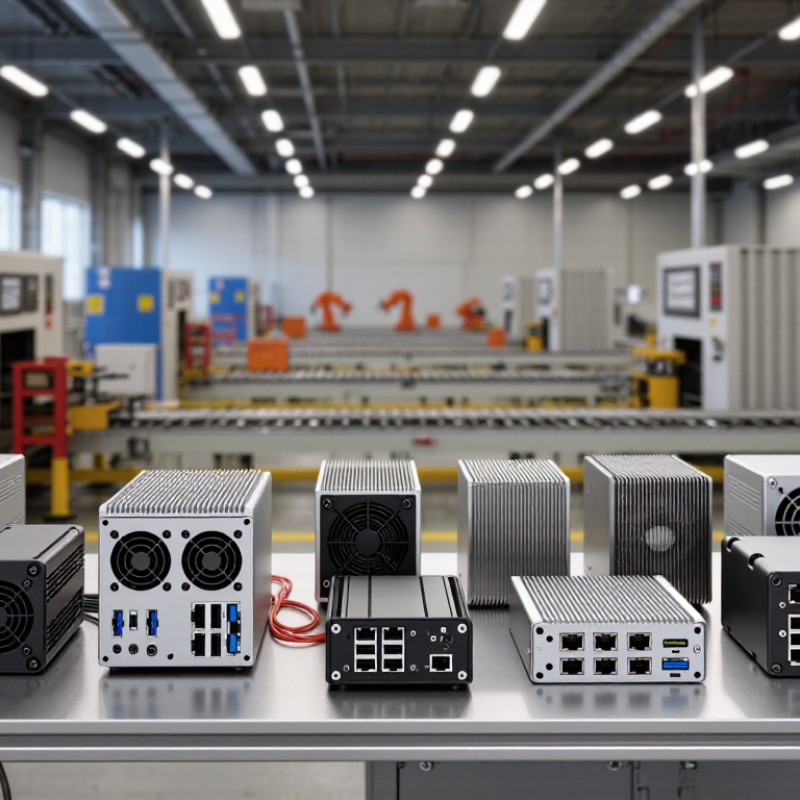
| 1 | Fanless modular edge computer | Typically 2–6 Ethernet ports, 2–8 USB ports, 2–6 serial ports, and optional digital I/O | Fanless construction removes a common wear component; verify the published MTBF calculation and operating-temperature conditions for the selected unit. | Often supports M.2 storage, wireless modules, and one or more modular I/O or communication expansions | Machine control, edge data collection, and space-constrained factory installations | A strong all-round choice when low maintenance and configurable connectivity matter. |
| 2 | DIN-rail embedded computer | Commonly 2–4 Ethernet ports, 2–6 serial ports, USB, and optional isolated digital I/O | Fanless models can reduce fan-related failures; assess thermal limits, power design, and the exact MTBF report. | Usually offers internal M.2 or mini-card slots; physical expansion is more limited than in larger systems | Control cabinets, protocol gateways, and distributed monitoring | Best where compact DIN-rail mounting is more important than multiple add-in cards. |
| 3 | Compact PCIe industrial computer | Typically 2–6 Ethernet ports, 4–8 USB ports, 2–8 serial ports, with optional digital I/O | Reliability depends on the complete configuration, cooling, and environment; compare reports based on consistent test assumptions. | One or more PCIe slots plus M.2 or SATA storage, depending on chassis size | Machine vision, motion systems, and applications needing specialized interface cards | Offers a useful balance between a small footprint and add-in-card flexibility. |
| 4 | Rackmount industrial computer | Often 2–8 Ethernet ports, multiple USB and serial ports, and configurable front- or rear-panel I/O | Check fan and power-supply service life alongside the MTBF figure; rack temperature and airflow affect reliability. | Multiple PCIe slots, drive bays, and replaceable storage or power components are common | Centralized control rooms, test systems, and factory server applications | Choose when serviceability and internal expansion outweigh cabinet space and power use. |
| 5 | Industrial panel PC | Commonly 2–4 Ethernet ports, USB, serial connectivity, and optional touch-panel controls | Display, touch layer, and cooling design affect system reliability; request separate component and system ratings where available. | Usually limited to internal M.2 or mini-card expansion; external I/O modules may be needed | Operator stations, HMI dashboards, and production-line visualization | Provides an integrated display and computer, but is less flexible for internal upgrades. |
| 6 | Industrial box PC with isolated I/O | May provide 8–32 isolated digital input/output channels, plus Ethernet, USB, or serial ports | Isolation can help protect interfaces from electrical disturbances, but it does not establish an MTBF value; check the system report. | Typically includes internal storage and wireless expansion; some versions accept external I/O modules | Equipment monitoring, discrete automation, and electrical-noise-prone environments | Confirm channel isolation, voltage ranges, and whether I/O is onboard or supplied by an add-on module. |
| 7 | Small-form-factor edge gateway | Usually 2–4 Ethernet ports, USB, and 1–4 serial ports; digital I/O varies by configuration | Passive cooling may improve serviceability, but thermal design and ambient temperature remain important MTBF factors. | Typically M.2 or mini-card expansion with limited room for full-size add-in cards | Data logging, protocol conversion, and local industrial networking | A practical option for gateway tasks where compact size and modest expansion are sufficient. |
| 8 | Rugged embedded computer | Often 2–4 Ethernet ports, USB, serial ports, and optional isolated or vehicle-specific I/O | Review the stated shock, vibration, and temperature test conditions; these ratings are distinct from MTBF. | Usually supports internal storage and wireless modules, with limited chassis expansion | Mobile machinery, outdoor equipment, and installations exposed to vibration | Prioritize environmental ratings and connector retention for harsh operating conditions. |
| 9 | DIN-rail programmable automation computer | Commonly Ethernet and serial ports, with local or modular digital and analog I/O options | Compare the computer and I/O-module reliability documentation separately; field wiring and load conditions also matter. | Often expands through side-mounted I/O modules or communication modules rather than PCIe cards | Compact process control and distributed automation tasks | Useful when a modular control-system layout is preferred over PC-style card expansion. |
| 10 | Industrial workstation computer | Typically several Ethernet and USB ports, multiple display outputs, and optional serial or digital I/O | Higher-performance CPUs and discrete graphics can increase heat; evaluate cooling, dust protection, and system-level MTBF. | Often provides multiple PCIe slots, memory sockets, and internal drive bays | Advanced machine vision, engineering stations, and compute-intensive inspection | Best for demanding workloads, but generally requires more space, power, and thermal management. |



 Close
Close