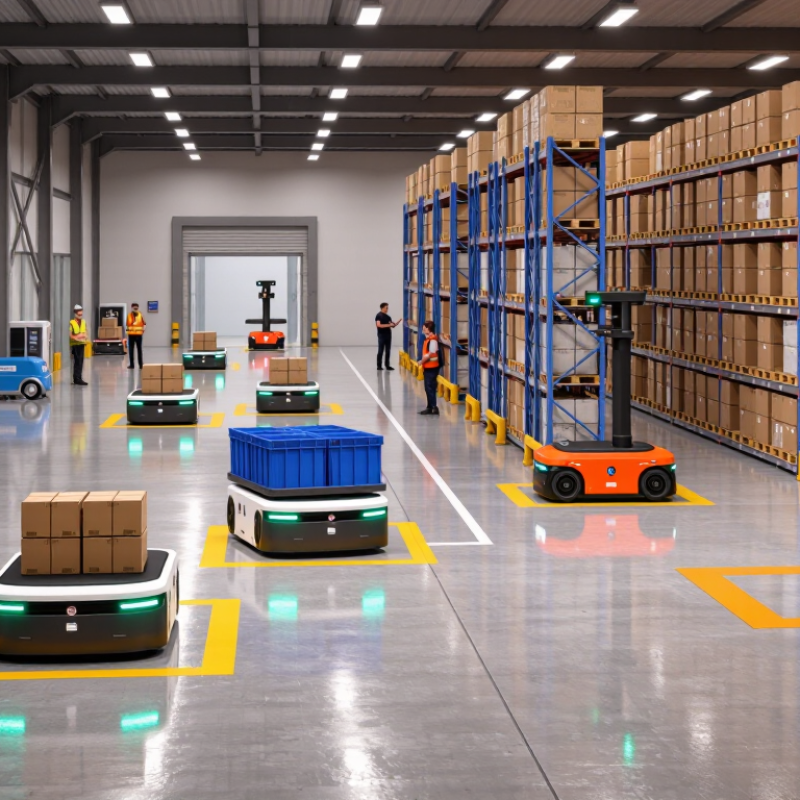
| Unit-Load AGV | Moves pallets, bins, totes, or containers between fixed loading and unloading points. | Magnetic tape, QR markers, laser guidance, or natural-feature mapping. | 500–2,000 kg | 0.8–1.5 m/s | Typically ±10–30 mm at transfer points. | Warehouses, assembly lines, packaging, and distribution centers. | Floor condition, transfer height, load dimensions, and interface compatibility. |
| Tugger AGV | Tows one or more carts in a train for repetitive line-side or warehouse replenishment. | Laser, magnetic guidance, QR codes, or mapped navigation. | 1,000–5,000 kg total train load | 0.6–1.2 m/s | Typically ±20–50 mm, depending on coupling and docking design. | Automotive, electronics, appliance, and manufacturing plants. | Turning radius, aisle width, trailer stability, and route congestion. |
| Forklift AGV | Automatically picks, transports, stacks, and retrieves palletized loads. | Laser navigation, reflector-based positioning, QR markers, or SLAM. | 1,000–3,000 kg | 0.8–1.5 m/s travel speed | Typically ±10–25 mm for pallet approach and placement. | High-bay warehouses, raw-material storage, cold chains, and factories. | Pallet quality, rack tolerances, floor flatness, safety zones, and lift height. |
| Pallet-Transport AGV | Lifts or carries pallets close to the floor and transfers them between workstations. | Natural-feature navigation, laser guidance, magnetic tape, or QR markers. | 500–1,500 kg | 0.8–1.5 m/s | Typically ±10–30 mm at docking locations. | Pallet staging, production feeding, finished-goods movement, and cross-docking. | Pallet entry clearance, conveyor height, load overhang, and docking repeatability. |
| Conveyor-Top AGV | Transfers cartons, totes, or pallets through powered roller or belt interfaces. | Laser, QR-code, magnetic, or mapped autonomous navigation. | 300–1,500 kg | 0.5–1.2 m/s | Typically ±10–20 mm for conveyor alignment. | Sortation, e-commerce fulfillment, parcel handling, and production logistics. | Conveyor height matching, load orientation, throughput, and communication protocols. |
| Cart-Based AGV | Carries custom carts, racks, work-in-process materials, or mobile fixtures. | SLAM, laser navigation, visual navigation, or floor markers. | 300–1,000 kg | 0.5–1.2 m/s | Typically ±15–40 mm. | Component kitting, assembly, healthcare logistics, and laboratory operations. | Cart coupling, load stability, aisle traffic, and workstation ergonomics. |
| Heavy-Load AGV | Moves large dies, coils, molds, engines, steel products, or other oversized loads. | Laser guidance, inertial navigation, wire guidance, or hybrid navigation. | 5,000–100,000+ kg | 0.2–0.8 m/s | Typically ±20–75 mm, based on load size and transfer requirements. | Steel, shipbuilding, aerospace, heavy equipment, and precast concrete. | Structural capacity, battery energy, emergency braking, surface strength, and turning geometry. |
| Cleanroom AGV | Transports sensitive materials in controlled environments with minimized particle generation. | Laser, magnetic, QR, or mapped navigation with controlled motion profiles. | 100–1,000 kg | 0.2–0.8 m/s | Typically ±10–30 mm. | Semiconductor, pharmaceutical, medical-device, and precision electronics production. | Cleanroom classification, materials of construction, particle control, and charging method. |
| Outdoor AGV | Performs automated transport across yards, docks, warehouses, or partially covered outdoor areas. | GNSS, LiDAR, radar, visual navigation, inertial sensors, or combined systems. | 1,000–40,000 kg | 0.5–2.0 m/s | Typically ±30–100 mm, depending on positioning technology and terrain. | Ports, logistics yards, construction-material sites, and inter-building transport. | Weather protection, drainage, lighting, road markings, connectivity, and mixed traffic. |
| Vision-Guided AGV | Uses cameras and computer vision to follow routes, recognize locations, and adapt to changing layouts. | Visual landmarks, 2D/3D cameras, LiDAR-assisted SLAM, or hybrid sensor fusion. | 100–2,000 kg | 0.5–1.5 m/s | Typically ±15–50 mm, subject to lighting and environmental conditions. | Flexible manufacturing, warehouses, hospitals, retail backrooms, and dynamic facilities. | Lighting variation, reflective surfaces, occlusion, floor markings, and data-processing capability. |



 Close
Close