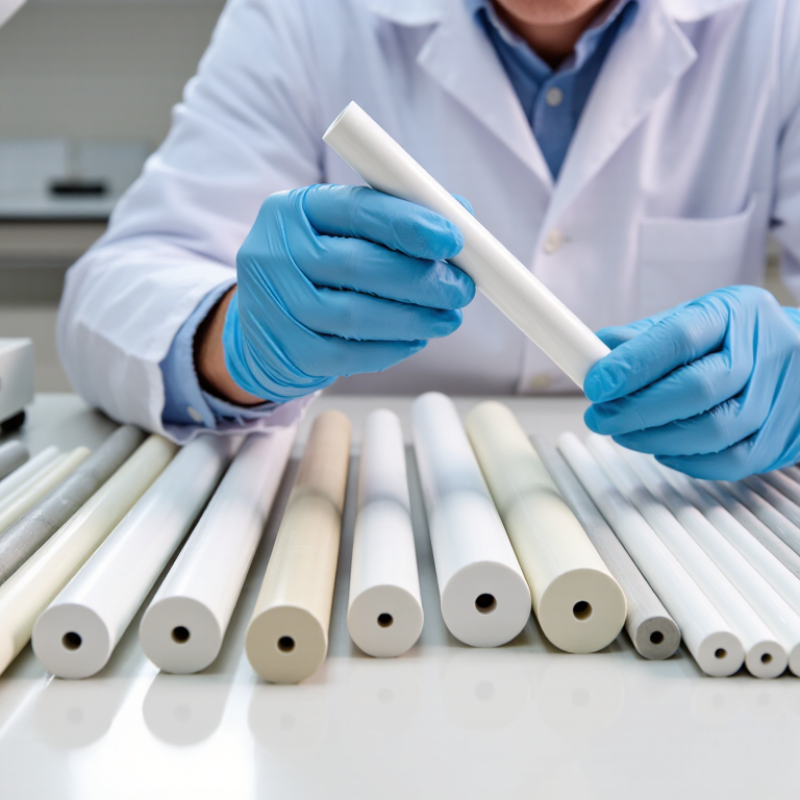
Choosing the right Ceramic Rod can determine whether a component performs reliably or fails under pressure. The choice affects strength, heat resistance, insulation, wear, and service life. A rod that looks smooth may still contain hidden flaws.
W. David Kingery, a respected ceramic materials scientist, famously said, “The history of ceramics is the history of mankind.” His observation reflects the long development of ceramic materials and their practical value. Modern buyers must apply that knowledge carefully.
A good selection begins with the working environment. Will the Ceramic Rod face sudden temperature changes, abrasive contact, electrical voltage, or corrosive chemicals? Alumina often suits electrical insulation and high-wear applications. Zirconia may offer greater toughness. Silicon nitride can perform well under demanding thermal conditions.
Dimensions matter more than many buyers expect. A small diameter error can create alignment problems in a precision assembly. Surface finish also deserves attention. Run your finger across the rod. Tiny scratches can become stress points.
Supplier documentation should include material grade, tolerance, density, hardness, and inspection results. Ask for traceability. Do not rely only on a product photograph.
Testing remains essential.
Samples should be checked under realistic loads and temperatures. In my experience, buyers sometimes select the hardest material and overlook thermal shock. That decision can be costly. No guide is flawless, either. Application data may be incomplete, and laboratory results may not match field conditions.
These ten tips provide a practical starting point. They help engineers compare materials, clarify specifications, and choose a Ceramic Rod with greater confidence.
Choosing a ceramic rod starts with its duty, not its diameter. Will it insulate electricity, resist abrasion, survive heat, or tolerate chemicals? Each requirement changes the material and geometry. Alumina is often selected for electrical insulation because ASM Handbook data places its thermal conductivity near 20–30 W/m·K and dielectric strength commonly above 10 kV/mm. However, purity, porosity, and surface finish can shift actual performance.
Tip: Write the duty in one sentence.
For abrasive contact, compare hardness, fracture toughness, and edge strength. ASTM C1161 testing helps evaluate ceramic flexural strength, but laboratory values do not perfectly represent vibrating assemblies. For continuous heat, check the full temperature cycle, not only the maximum rating. Thermal shock can crack a rod during rapid cooling. IEC 60672 guidance also reminds engineers to classify insulating ceramics by electrical and mechanical service, rather than relying on one property.
Chemical service needs equal caution. A rod exposed to acids, alkalis, molten salts, or cleaning fluids may require a specific ceramic composition and glaze. Review compatibility data at the actual concentration and temperature. I once treated “chemically resistant” as a complete answer. It was not. Small pores became the weak point.
Tip: Match the test environment to the process.
Ask for batch-level dimensional tolerance, density, porosity, and inspection records. ASTM C373 methods can support water absorption and apparent porosity checks. Small differences matter. A tight-fit rod may fail from installation stress, even when its material data looks excellent. Verify load, span, heating rate, and mounting details before approving the design.



 Close
Close