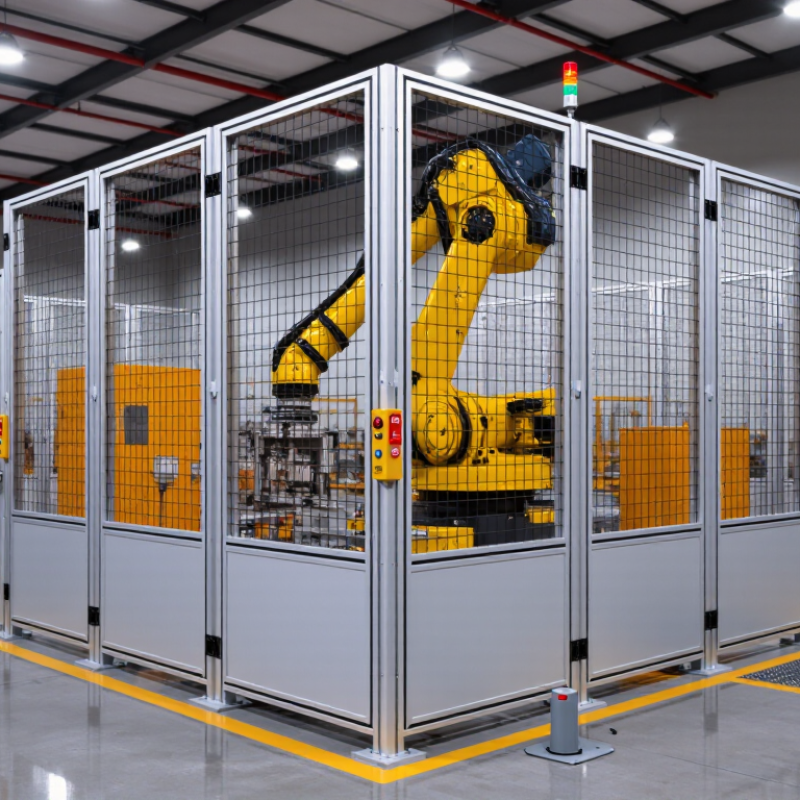
| Fence Panel and Post Condition | Confirm that the physical barrier remains capable of preventing unintended access to the robot hazard zone. | Visually inspect panels, posts, brackets, welds, fasteners, and protective coatings. Check for bending, cracks, corrosion, sharp edges, and missing hardware. | No loose, damaged, corroded, or sharp components; panels remain securely supported and cannot be displaced by normal operating forces. | Before each shift and after any impact, modification, or abnormal event. | Inspection date, inspector, findings, corrective action, and close-out date. |
| Guard Opening and Reach-Through Protection | Prevent a person from reaching the robot or other hazardous moving parts through, over, under, or around the fence. | Measure openings and distances from the fence to hazardous motion. Evaluate reach paths using the applicable safety-distance and reach-distance criteria. | Openings and separation distances comply with the risk assessment and applicable machinery-safety requirements; no accessible hazard remains during normal operation. | During commissioning and whenever the fence, robot layout, tooling, or hazard position changes. | Measured dimensions, risk-assessment reference, test equipment, and approval signature. |
| Access Door Alignment and Mechanical Condition | Ensure that doors close fully and cannot be easily defeated, bypassed, or left partially open. | Open and close each door repeatedly. Check hinges, latches, stops, handles, alignment, sagging, and clearance. Apply the normal operating force to verify stability. | Door closes completely, latches correctly, does not bind, and cannot be opened unintentionally from the protected side. | Weekly and after maintenance, impact, or door adjustment. | Door identification, inspection result, defects, and repair details. |
| Interlock Device Function | Ensure that opening a guarded access point initiates the required safety response. | With the robot operating in a controlled test condition, open each access door and verify that the safety-related stop function is initiated. Attempt restart while the door is open. | Hazardous motion stops as defined by the risk assessment, and automatic or normal restart is prevented while the door is open. | At commissioning, before each shift where required by the risk assessment, and after interlock maintenance. | Door number, stop response, restart test result, and person performing the test. |
| Emergency Stop Function | Verify that emergency-stop devices provide a readily accessible means of stopping hazardous motion. | Activate each emergency-stop device during a controlled test. Confirm that motion stops and that the device remains actuated until manually reset. | The required stop category and response are achieved; reset does not by itself restart the robot; all emergency-stop devices are clearly identified and accessible. | Before operation and after electrical or control-system work. | Device location, activation result, reset result, and corrective actions. |
| Safety-Control Circuit Monitoring | Detect faults in interlocks, emergency stops, wiring, or safety-related control components before the machine can operate unsafely. | Use the approved diagnostic or validation procedure to test input channels, output channels, reset logic, and fault detection. Do not introduce faults unless the procedure is authorized and controlled. | The safety function responds to the defined single faults and produces the required diagnostic or safe-state response. | During initial validation, after control-system changes, and at the interval specified by the safety system assessment. | Safety-function identifier, test procedure, results, faults detected, and validation approval. |
| Robot Stopping Performance | Confirm that the robot stops within the time and distance used to establish the protective separation distance. | Measure stopping time and, where applicable, stopping distance under representative payload, speed, program, and tool conditions. Use calibrated measurement equipment and the approved test method. | Measured stopping performance does not exceed the values used in the risk assessment and safety-distance calculation. | At commissioning, after changes to speed, payload, software, tooling, or safety controls, and at the interval defined by the risk assessment. | Operating conditions, measured time or distance, instrument details, and comparison with design values. |
| Fence Stability and Anchorage | Ensure that the enclosure remains fixed and maintains the required protective position during operation. | Inspect floor anchors, base plates, joining brackets, fasteners, and post plumbness. Check for movement, vibration damage, and interference with nearby equipment. | Anchors and fasteners are secure, posts remain stable, and the fence has no movement that could create an access gap or reduce protection. | Monthly and after relocation, impact, construction work, or significant vibration. | Anchor inspection results, torque or condition checks where specified, and repair records. |
| Safety Signage and Access Identification | Communicate the presence of hazards, restricted access, and required operating controls. | Check warning signs, restricted-entry labels, emergency-stop labels, and access-point identification for visibility, legibility, and correct placement. | Signs are visible from relevant approach points, readable, securely attached, and consistent with the current hazard and operating procedure. | Monthly and whenever the cell layout or hazard information changes. | Signage checklist, location, condition, and replacement date if applicable. |
| Housekeeping and Clearances | Prevent stored materials, debris, cables, or tools from creating bypass routes or obstructing safe access. | Inspect the perimeter, door swing area, emergency-stop access, floor condition, and space around the robot cell. Remove unauthorized objects. | No material blocks access, interferes with door operation, creates a climb-over route, or obstructs emergency controls. | Before each shift and during routine operator inspections. | Operator checklist and records of repeated housekeeping issues. |
| Change-Control Review | Ensure that modifications do not reduce the effectiveness of the safeguarding system. | Review changes to robot programs, tooling, production speed, fence layout, access points, safety circuits, and nearby equipment. Repeat affected validation tests. | The risk assessment, safety-distance calculation, drawings, procedures, and validation records are updated before release to production. | Whenever a change may affect the hazard, safeguarding, stopping performance, or safety-related control system. | Change request, revised documents, test results, authorization, and implementation date. |
| Periodic Functional Audit | Confirm that the complete safeguarded cell continues to perform as intended over its service life. | Perform a documented review of fence integrity, access controls, emergency stops, stopping performance, signage, maintenance history, and outstanding corrective actions. | All required safety functions pass testing, deficiencies are corrected or formally controlled, and records remain traceable. | At the interval established by the risk assessment and site procedures; review at least after significant incidents or modifications. | Signed audit report, open-action list, completion evidence, and next review date. |



 Close
Close