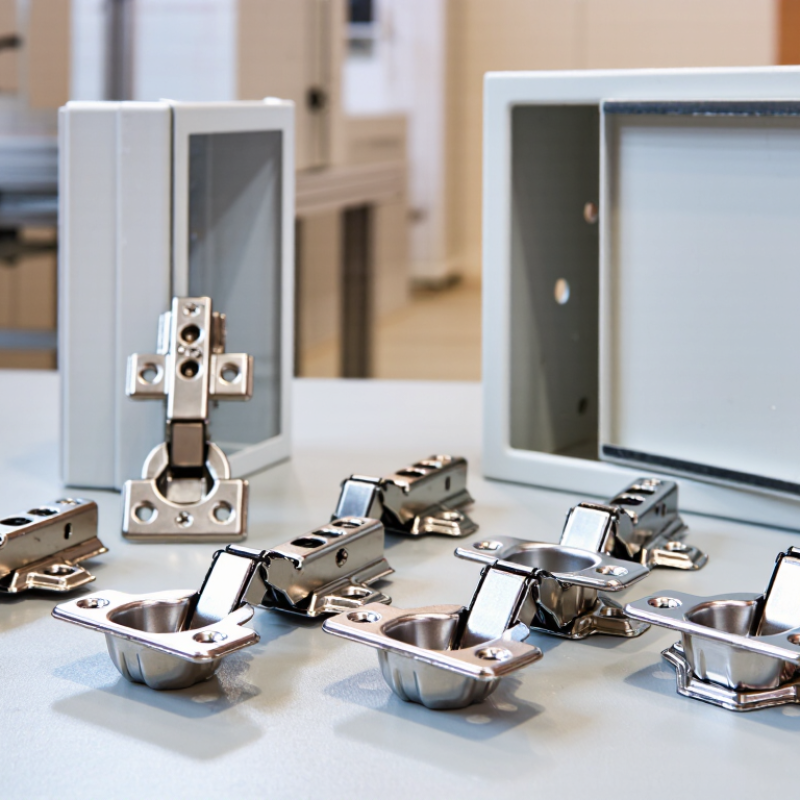
| Definition | An industrial panel hinge is a mechanical joint that connects a cabinet door, access panel, inspection cover, or enclosure lid to its frame and allows controlled rotation. | Provides repeatable opening and closing while keeping the panel attached to the enclosure. | Confirm the panel weight, dimensions, center of gravity, mounting space, and required opening angle. |
| Common Applications | Electrical cabinets, control panels, automation enclosures, machine guards, switchboards, server cabinets, and outdoor equipment housings. | Enables service access, inspection, component replacement, and routine maintenance. | The hinge should suit the enclosure construction, access frequency, operating environment, and safety requirements. |
| Typical Hinge Types | Concealed hinges, external hinges, lift-off hinges, continuous piano hinges, adjustable hinges, friction hinges, and spring-loaded hinges. | Different designs provide space saving, easy panel removal, long support length, controlled positioning, or assisted opening. | Select the type according to accessibility, security, clearance, maintenance method, and required movement control. |
| Common Materials | Stainless steel, zinc-plated steel, nickel-plated steel, aluminum, zinc alloy, and engineering plastics are commonly used. | Material choice affects corrosion resistance, strength, weight, appearance, and compatibility with the enclosure. | Stainless steel is generally preferred for corrosive or washdown environments; plated steel is often used for general indoor equipment. |
| Opening Angle | Industrial hinges are commonly designed for opening angles such as 90°, 120°, 180°, or other specified positions. | Determines how far the door or panel can open for operation and maintenance access. | Check the manufacturer’s angle rating and verify that nearby walls, cables, handles, and adjacent doors do not obstruct movement. |
| Load Capacity | Load capacity is application-specific and depends on hinge quantity, spacing, panel mass, center of gravity, fasteners, and operating cycle. | Supports the panel and transfers the door load to the enclosure frame. | Use the rated load or moment supplied for the exact hinge model; do not select solely by appearance or nominal size. |
| Mounting Methods | Common methods include screws, bolts, weld studs, captive fasteners, threaded inserts, and clip-in or snap-in mounting. | Provides structural attachment and determines installation time and serviceability. | Match the mounting method to panel thickness, hole pattern, access from both sides, vibration level, and production process. |
| Security and Tamper Resistance | Concealed or internal hinges can reduce external access to the hinge hardware and improve enclosure security. | Helps protect electrical, automation, and control components from unauthorized access or accidental interference. | Consider hinge visibility, removable-pin risks, lockable handles, and the complete enclosure security design. |
| Environmental Resistance | Performance may be affected by moisture, salt spray, chemicals, dust, temperature changes, vibration, and outdoor exposure. | Maintains reliable panel movement and attachment under operating conditions. | Evaluate corrosion-resistant materials, surface treatment, lubrication requirements, and compatibility with the enclosure’s sealing system. |
| Ingress Protection Relationship | A hinge alone does not establish an enclosure’s IP rating. The complete assembly, including seals, door design, fasteners, and testing, determines protection. | Allows the door to move without damaging gaskets or creating excessive gaps. | For sealed enclosures, verify the complete enclosure design and applicable testing requirements rather than relying on a hinge specification alone. |
| Operating Temperature | The usable temperature range depends on the hinge material, lubricant, polymer components, coatings, and surrounding equipment. | Ensures predictable movement and load performance in indoor, outdoor, hot, or cold installations. | Obtain the temperature range for the complete hinge assembly, including seals, bearings, bushings, and lubricants. |
| Service Life | Service life is normally expressed through cycle testing or an application-specific durability requirement. | Supports repeated access during production, inspection, and maintenance. | Request cycle-test information when the panel is opened frequently or when downtime has a high operational cost. |
| Dimensional Compatibility | Important dimensions include hinge length, leaf width, knuckle diameter, pin diameter, mounting-hole spacing, offset, and clearance. | Ensures correct alignment between the door and the enclosure frame. | Use a technical drawing or CAD model to confirm fit before production or replacement. |
| Quality Verification | Typical checks include dimensional inspection, material verification, surface inspection, load testing, cycle testing, and corrosion evaluation where applicable. | Reduces installation problems, premature wear, misalignment, and unexpected maintenance. | Request inspection records, drawings, samples, and test conditions that correspond to the intended application. |



 Close
Close