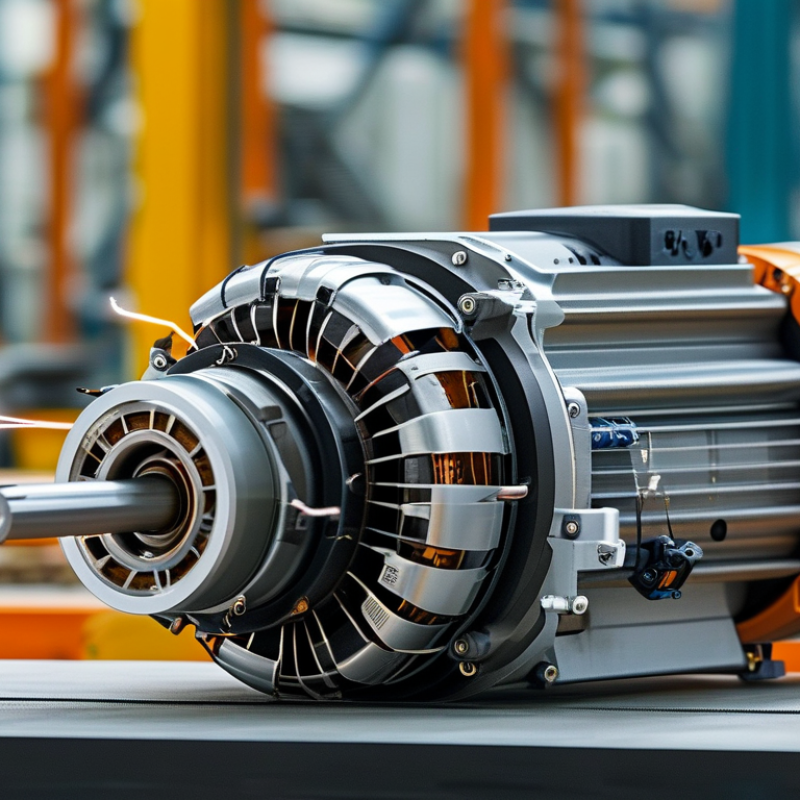
| Definition | Electronically commutated permanent-magnet motor | A brushless DC motor uses permanent magnets on the rotor and electronically controlled current switching instead of mechanical brushes and a commutator. |
| Typical Industrial Power Range | Approximately 100 W to 100 kW | The practical range depends on the motor frame, cooling method, duty cycle, voltage, and application. Smaller units are common in automation, while larger versions support pumps, conveyors, and machine tools. |
| Common DC Bus Voltage | 24 V, 48 V, 72 V, 120 V, 240 V, and 310–325 V DC | The selected voltage must match the inverter, insulation system, safety requirements, and available power supply. Higher bus voltage generally reduces current for the same power output. |
| Motor Construction | Stationary stator with windings; rotating permanent-magnet rotor | The stator generates a rotating magnetic field, while rotor magnets follow that field to produce torque. This arrangement eliminates brush wear inside the motor. |
| Stator Core | Laminated electrical steel with copper windings | Laminations reduce eddy-current losses, while the distributed or concentrated windings create the electromagnetic field required for rotation. |
| Rotor Assembly | Permanent magnets mounted on or embedded in the rotor | Surface-mounted magnets are often used for compact, high-speed designs; embedded magnets can improve mechanical retention and field-weakening capability. |
| Electronic Commutation | Power inverter switches phase current electronically | A controller energizes the motor phases in sequence according to rotor position. Six-step trapezoidal commutation is common, while sinusoidal or field-oriented control provides smoother operation. |
| Position Feedback | Hall sensors, encoders, resolvers, or sensorless estimation | Feedback enables accurate commutation and speed control. Hall sensors are economical, while encoders and resolvers provide higher position resolution for demanding motion systems. |
| Typical Speed Range | Approximately 500 to 20,000 rpm | The actual speed range is determined by pole count, bearing design, rotor balance, back-EMF, load torque, and cooling capacity. High-speed designs require careful mechanical and thermal analysis. |
| Torque Characteristics | High starting torque; near-constant torque below base speed | With suitable current control, a BLDC motor can deliver strong acceleration and stable torque. Above base speed, field weakening may be used, subject to voltage and thermal limits. |
| Typical Efficiency | Approximately 80% to 95% at rated operating points | Efficiency varies with load, speed, winding resistance, iron loss, inverter loss, magnet design, and cooling. Peak efficiency does not occur at every operating condition. |
| Control Methods | Six-step control, sinusoidal control, and field-oriented control | Six-step control is relatively simple; sinusoidal and field-oriented control can reduce torque ripple and acoustic noise while improving dynamic performance. |
| Cooling Options | Natural convection, forced air, liquid cooling, or conduction cooling | Cooling removes copper, iron, bearing, and inverter-related heat. Continuous output is limited by the thermal path from the windings and housing to the environment. |
| Torque Ripple | Low to moderate, depending on design and control | Cogging torque, commutation strategy, slot-pole combination, current waveform, and position accuracy all influence vibration and speed uniformity. |
| Maintenance Requirement | Low routine maintenance; bearings and seals still require inspection | The absence of brushes removes a common wear component, but bearings, insulation, connectors, cooling paths, and feedback devices remain service items. |
| Industrial Advantages | High power density, fast response, compact size, and precise speed control | These characteristics make BLDC motors suitable for servo actuators, robotics, pumps, fans, conveyors, automated tooling, and other variable-speed equipment. |
| Key Design Limitations | Requires an electronic drive; magnets and electronics have temperature limits | System cost and complexity include the inverter, controller, feedback, electromagnetic compatibility measures, and protective functions. Excessive temperature can reduce magnet strength and insulation life. |



 Close
Close