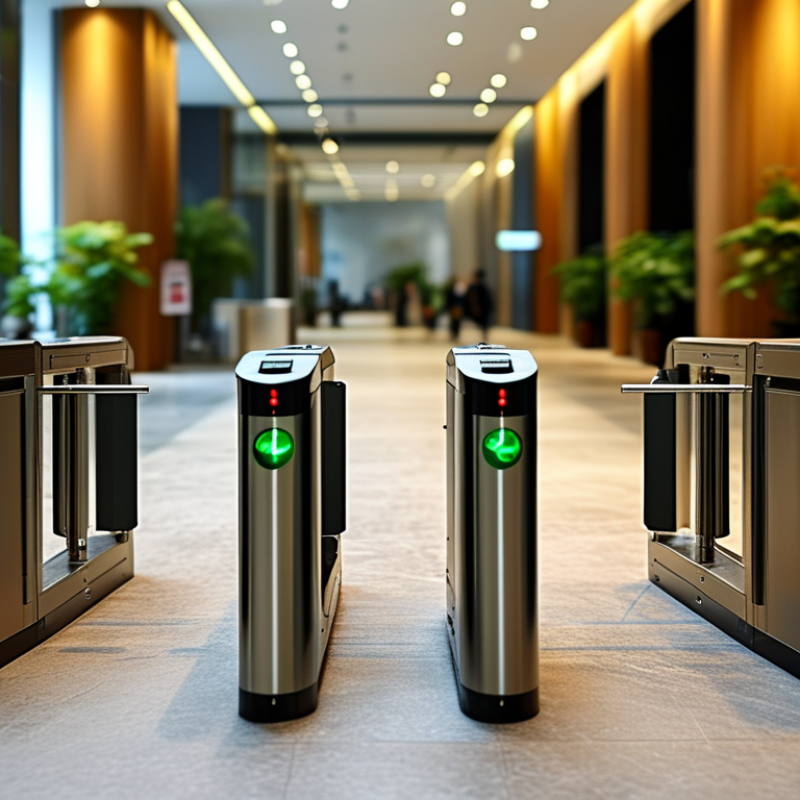
| Basic Operating Principle | An entrance-control barrier with two retractable or swinging panels that regulate pedestrian access. | A valid credential sends an opening signal to the motor or actuator. The panels open, detect passage, and close after the user crosses. | One authorized person per passage cycle; configurable opening and closing time. | Choose a bidirectional model when the entrance must support both entry and exit. |
| Standard Passage Width | The clear distance between the two barrier cabinets or between the flap panels. | The control system opens the panels to create the selected walking lane. | Approximately 550–600 mm for standard lanes; approximately 900–1,000 mm for accessible lanes. | Use at least one accessible lane of approximately 900 mm clear width where building access requirements apply. |
| Pedestrian Throughput | The approximate number of people who can pass through one lane during normal operation. | Throughput depends on authentication speed, user spacing, opening time, and anti-tailgating settings. | Typically about 25–35 persons per minute with credential-based access and orderly movement. | Compare tested throughput using the same credential technology and passage conditions. |
| Authentication Methods | The technologies used to verify whether a person is authorized to enter. | The gate controller receives a permission signal from an access-control reader or security system. | Common options include RFID cards, NFC credentials, QR codes, PIN keypads, biometric readers, and mobile credentials. | Select an open interface such as Wiegand or OSDP when integration flexibility and encrypted reader communication are required. |
| Safety Detection | Sensors that help prevent the panels from closing on a person or object. | Infrared or other presence sensors monitor the passage area and can stop, reopen, or hold the flaps when an obstruction is detected. | Typical systems use multiple detection zones, including entrance, center, and exit monitoring. | Prioritize adjustable presence detection, obstruction reversal, and an emergency release function. |
| Anti-Tailgating and Anti-Passback | Security functions designed to prevent unauthorized users from following an authorized user through one opening cycle. | Passage sensors compare the credential event with the movement of people through the lane. | Detection performance varies with sensor layout, walking speed, user spacing, and control logic. | Choose a model with configurable detection sensitivity and event logging for higher-security locations. |
| Emergency and Power-Failure Behavior | The gate’s response during fire alarms, emergency signals, or loss of electrical power. | A fire-alarm or emergency input can command the panels to open; a backup battery or mechanical release may support controlled operation. | Fail-safe opening is commonly selected for evacuation routes, while fail-secure behavior may be used for restricted security zones where legally permitted. | Confirm the required emergency mode with the local fire-safety authority and building regulations. |
| Operating Speed | The time required for the panels to open and close after authorization. | A motor, gearbox, or actuator moves the panels according to programmed acceleration and timing. | Many commercial systems complete an opening or closing movement in roughly 0.5–1.5 seconds, depending on the design and safety settings. | Choose adjustable speed rather than maximum speed alone, especially in schools, hospitals, and crowded lobbies. |
| Cabinet and Flap Materials | The structural materials used for the housing and barrier panels. | The cabinet supports the drive mechanism, sensors, controller, and reader installation. | Common construction includes stainless steel or coated steel cabinets with tempered-glass, acrylic, or polycarbonate flaps. | Use corrosion-resistant stainless steel in public areas and higher-impact transparent panels where visibility is important. |
| Ingress Protection | The degree of protection against dust and water entering the equipment enclosure. | The enclosure design and seals reduce exposure of electrical and mechanical components to the environment. | Indoor models commonly use basic protected enclosures; outdoor models should be selected with a verified outdoor IP rating. | For exposed installations, specify a documented rating such as IP54 or higher when suitable for the site conditions. |
| Installation Environment | The location and conditions in which the gate will operate. | Floor levelness, drainage, temperature, humidity, lighting, and pedestrian flow affect reliable operation. | Best suited to level, stable floors in offices, transit facilities, campuses, gyms, and controlled public entrances. | Use an indoor unit for dry lobbies; select an outdoor-rated design for unprotected entrances. |
| Power Requirements | The electrical supply needed to operate the controller, sensors, reader, and drive system. | The power supply converts building electricity to the low-voltage power used by the gate electronics and motor. | Commercial units commonly use 100–240 V AC input with internal low-voltage electronics; exact consumption varies by model and operating cycle. | Verify voltage, standby consumption, peak motor demand, grounding, and backup-power compatibility before installation. |
| Control and Integration | The electrical and software connection between the gate and a wider access-control system. | Inputs and outputs exchange authorization, door status, alarm, emergency, and passage events. | Common interfaces include relay inputs and outputs, Wiegand, RS-485, OSDP, Ethernet, and API-based integration. | Choose documented interfaces and status feedback when connecting to visitor management, elevator control, CCTV, or a central security platform. |
| Maintenance Requirements | The routine inspection, cleaning, adjustment, and replacement work needed to keep the gate reliable. | Technicians inspect sensors, fasteners, panels, drive components, wiring, and emergency-release functions. | Maintenance frequency depends on traffic, dust, humidity, impact risk, and manufacturer instructions. | Plan periodic inspection and keep critical items such as sensors, panels, fuses, and drive components available. |
| Accessibility and User Flow | The design features that allow people with mobility aids, luggage, or strollers to pass safely. | A wider lane and suitable sensor configuration provide additional clearance and more controlled movement. | Accessible lanes are commonly designed around approximately 900–1,000 mm clear width, subject to local requirements. | Provide clear signage, adequate approach space, visual status indicators, and a wider lane where required. |
| Best-Fit Application | The type of site where the gate provides the most practical balance of security, appearance, and pedestrian control. | The system combines credential verification, barrier movement, passage detection, and event reporting. | Well suited to office lobbies, corporate campuses, educational facilities, fitness centers, residential buildings, and controlled public venues. | Choose flap gates for organized pedestrian traffic where a visible, compact, and relatively quiet barrier is preferred. |
| Limitations to Consider | Conditions in which a flap turnstile may not be the most suitable access solution. | The mechanism relies on correct sensor alignment, controlled pedestrian behavior, and a suitable installation environment. | It may be unsuitable for vehicle access, heavily exposed outdoor locations without weather protection, or sites requiring frequent trolley and large-equipment movement. | Consider swing gates, sliding doors, or full-height turnstiles when the site requires wider equipment access, stronger perimeter resistance, or different weather performance. |



 Close
Close