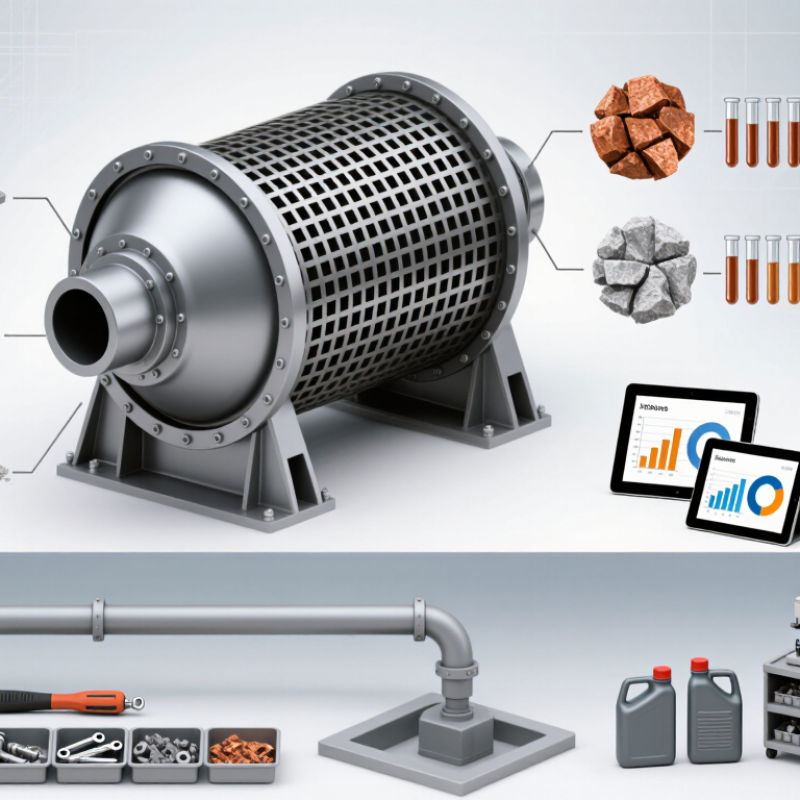
| Process Fit | Mill type | Wet overflow and wet grid-discharge mills are common; a grid mill is generally selected when faster discharge and higher throughput are required. | Match the discharge design with ore density, pulp viscosity, required product size, and the circuit classification method. | The supplier recommends the same discharge arrangement without reviewing the complete grinding circuit. |
| Capacity | Fresh-feed throughput | Industrial wet ball-mill circuits may range from below 10 t/h to more than 200 t/h, depending on mill size, ore hardness, feed size, and product target. | Require testwork-based capacity at the specified feed size, Bond Work Index, pulp density, and product size. | Capacity is stated without feed-size, hardness, product-size, or water-consumption conditions. |
| Mill Size | Shell diameter and length | Common industrial dimensions are approximately 1.2–5.5 m shell diameter and 1.8–8.5 m shell length; actual selection depends on duty and installed power. | Confirm foundation loads, transport limits, maintenance clearance, and access for liner replacement. | Overall dimensions are supplied without total operating weight or foundation drawings. |
| Installed Power | Motor rating | Wet ball mills commonly use motors from approximately 55 kW to over 2,000 kW across different sizes and duties. | Compare specific energy consumption in kWh/t at the same feed and product conditions, not motor size alone. | A larger motor is presented as proof of better performance without a kWh/t guarantee. |
| Grinding Media | Media size and filling | Ball filling is often designed around approximately 25–40% of mill volume; media size is selected according to feed size and final product size. | Request the proposed ball-size distribution, initial charge mass, top-up rate, and media consumption per tonne. | No media-consumption estimate or operating range is provided. |
| Cost | Total cost of ownership | Major cost items include mill equipment, motor and drive, foundation, piping, slurry pumps, classification, liners, grinding media, energy, labor, and downtime. | Compare purchase price, installation cost, annual energy, liner cost, media cost, spare parts, and planned downtime over a five-year period. | The lowest equipment price is quoted without freight, commissioning, spares, taxes, or civil works. |
| Energy | Specific energy consumption | A practical comparison should use kWh/t of fresh feed. Actual values vary significantly with ore hardness, size reduction ratio, classification efficiency, and mill loading. | Ask for guaranteed or test-validated kWh/t values under defined operating conditions. | Energy claims are given only as motor power or amperage. |
| Safety | Machine guarding and isolation | The drive, couplings, rotating shafts, feed openings, discharge areas, and maintenance access points require guarding and lockout/tagout provisions. | Verify emergency stops, interlocks, guarding, isolation points, working platforms, lifting devices, and electrical protection. | Operators must access rotating equipment or remove guards for routine inspection. |
| Structural Safety | Shell, trunnion, and foundation design | The design should account for static load, dynamic load, start-up torque, charge impact, bearing loads, and fatigue stresses. | Request mechanical calculations, material certificates, weld inspection records, and foundation-load data. | No engineering documents are available for the shell, trunnions, or base. |
| Liners | Liner material and service life | Rubber, composite, and steel liners are used according to impact severity, abrasion, mill diameter, temperature, and chemical conditions. | Compare expected liner life in operating hours, replacement weight, fastening method, and spare-liner availability. | Liner life is stated without ore abrasiveness, operating hours, or wear measurement method. |
| Maintenance | Inspection frequency | Routine checks are commonly performed each shift; lubrication, alignment, vibration, and liner inspections require scheduled intervals based on duty and condition. | Obtain a preventive-maintenance schedule covering bearings, pinion, girth gear, lubrication, bolts, liners, and slurry seals. | The manual lists only corrective maintenance and provides no inspection intervals. |
| Availability | Planned and unplanned downtime | Availability depends on duty severity, spare-parts strategy, liner-change time, lubrication, operator practice, and upstream/downstream reliability. | Use a documented availability target and identify the longest maintenance task and required critical spares. | Availability is advertised without defining the measurement period or excluding auxiliary-equipment downtime. |
| Water and Slurry | Pulp density and process-water demand | Wet grinding performance is sensitive to solids concentration, viscosity, rheology, and circulating-load control; there is no single suitable density for every ore. | Require the design solids percentage, slurry flow, pump duty, overflow arrangement, and water-balance assumptions. | The mill is sized without a slurry-flow or water-balance calculation. |
| Controls | Monitoring and automation | Useful measurements include motor power, bearing temperature, vibration, lubrication pressure, feed rate, slurry density, and discharge flow. | Check PLC/DCS compatibility, alarm logic, trend recording, interlocks, remote diagnostics, and instrument calibration requirements. | Only motor current is monitored while bearing, lubrication, and vibration data are unavailable. |
| Supplier Capability | Relevant references | The supplier should demonstrate comparable wet-grinding installations by mill size, power, ore type, throughput, and operating environment. | Request verifiable references, performance records, commissioning scope, warranty terms, and local service capability. | References are unrelated to wet grinding or cannot be independently verified. |
| Delivery | Lead time and project scope | The total schedule includes engineering, manufacturing, inspection, transport, foundation readiness, installation, commissioning, and performance testing. | Clarify delivery milestones, document list, inspection hold points, packing requirements, and responsibility for installation. | The quoted delivery date covers only factory shipment and excludes site commissioning. |
| Acceptance | Performance guarantee | A complete acceptance test should define throughput, product-size distribution, specific energy, water conditions, vibration, noise, and operating stability. | Include test methods, sampling frequency, measurement tolerances, corrective actions, and warranty consequences in the contract. | The contract guarantees equipment delivery but does not define process performance. |



 Close
Close