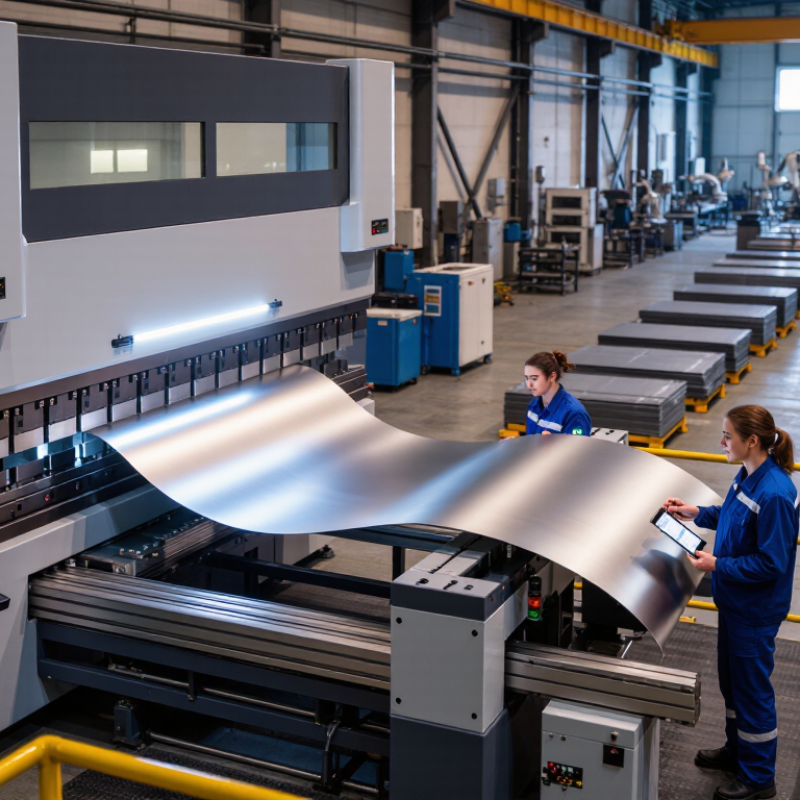
| Basic Definition | A laser bending machine is an automated sheet-metal forming system that uses a focused laser to heat selected bend lines and create controlled deformation. | Confirm whether the equipment performs laser forming, laser-assisted bending, or conventional press-brake bending with a laser measurement system. |
| Operating Principle | The laser heats a narrow path on the sheet. Thermal expansion and contraction generate a bending moment, producing an angle without a conventional punch-and-die operation. | Check the control system’s ability to regulate laser power, scanning speed, focal position, and heating patterns. |
| Typical Laser Source | Fiber lasers are commonly selected for their high electrical efficiency, compact design, and low maintenance requirements. Industrial systems may use power levels from approximately 1 kW to several kilowatts, depending on the process. | Match laser power and wavelength to the material, thickness, absorptivity, required heating width, and production cycle. |
| Compatible Materials | Common materials include mild steel, stainless steel, aluminum, and selected high-strength alloys. Material behavior varies with reflectivity, thermal conductivity, and hardness. | Request process trials using the exact grades, surface finishes, thicknesses, and coatings used in production. |
| Suitable Sheet Thickness | Laser forming is generally most effective on thin and medium-gauge sheet. Practical limits depend strongly on material, laser power, bend geometry, and required angle. | Evaluate the full thickness range rather than relying on a single maximum thickness specification. |
| Bending Angle Capability | The achievable angle is process-dependent. Multiple passes, different scanning directions, or preheating may be required for larger angles or difficult materials. | Verify angle repeatability on real parts and identify whether the machine can compensate for springback and thermal distortion. |
| Dimensional Accuracy | Accuracy depends on material consistency, laser stability, motion control, fixturing, heat dissipation, and calibration. Closed-loop measurement can improve repeatability. | Ask for test-part results, measurement methods, calibration intervals, and documented repeatability under production conditions. |
| Processing Speed | Cycle time depends on bend length, material thickness, laser power, scanning speed, number of passes, loading, unloading, and inspection. | Compare complete cycle time, not only laser scanning speed. Include setup, alignment, handling, and quality-control time. |
| Work Area | Available working dimensions vary by machine design. Larger work areas support bigger sheets but usually require more floor space and higher investment. | Select a work envelope that accommodates current parts, future products, fixtures, safety clearance, and material handling. |
| Automation Level | Options may include automatic loading, positioning, clamping, laser path generation, optical measurement, unloading, and production-data collection. | Choose automation according to batch size, labor availability, changeover frequency, and required traceability. |
| Programming and Software | Modern systems may import CAD files, simulate thermal deformation, generate laser paths, store recipes, and connect with manufacturing software. | Check CAD compatibility, offline programming, simulation accuracy, user access controls, and training requirements. |
| Fixturing Requirements | Fixtures must hold the sheet securely while allowing controlled thermal expansion and preventing unwanted movement. | Review fixture changeover time, accessibility, thermal resistance, alignment features, and compatibility with irregular parts. |
| Surface Quality | Laser forming can reduce tool marks because the process does not necessarily require direct punch contact, but discoloration, oxidation, or local heat effects may occur. | Test painted, coated, polished, and protective-film materials to determine whether masking or post-processing is needed. |
| Energy Consumption | Energy use is influenced by laser output power, duty cycle, cooling, motion systems, extraction, and automation. Fiber laser systems are generally more efficient than older laser technologies. | Request measured energy consumption per completed part, including chiller, extraction, controls, and auxiliary equipment. |
| Maintenance Needs | Routine tasks may include cleaning optics, checking cooling circuits, inspecting filters, calibrating sensors, lubricating motion components, and updating software. | Confirm preventive-maintenance schedules, spare-parts availability, remote diagnostics, and local technical support. |
| Safety Requirements | High-power lasers require engineered protection such as enclosed beam paths, interlocked doors, emergency stops, warning indicators, ventilation, and appropriate laser safety controls. | Verify compliance with applicable workplace, electrical, machine, and laser-safety regulations in the installation location. |
| Best-Fit Applications | Typical applications include lightweight enclosures, panels, brackets, aerospace components, architectural parts, prototypes, and low-volume products with complex bend patterns. | Compare the process with a press brake, roll forming, stamping, or manual forming based on volume, geometry, tooling, and tolerance. |
| Total Cost of Ownership | Total cost includes equipment, laser source, cooling, extraction, fixturing, software, installation, training, maintenance, electricity, labor, and downtime. | Calculate cost per acceptable part over the expected service life instead of comparing purchase price alone. |



 Close
Close