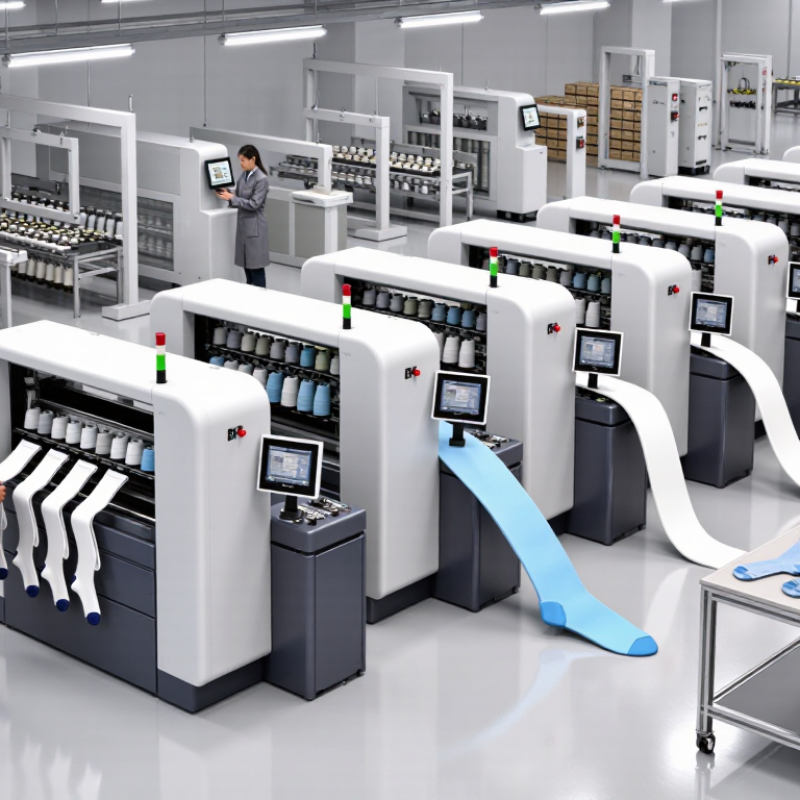
| Basic single-cylinder circular sock machine | Knits the sock as a circular fabric tube. Heel and toe formation depends on the machine’s functions and selected production process. | Can produce common sock sections such as cuffs, legs, and feet. Available stitch patterns and shaping options depend on needle-selection and control features. | Suitable for standard sock shapes; anatomical shaping depends on whether the machine supports heel and toe knitting functions. | A basic configuration may offer fewer patterning or shaping options. Some operations may require separate handling or finishing. | Core styles, straightforward production, and buyers prioritizing a simpler machine setup. | Confirm supported sock sizes, needle count and cylinder options, heel-and-toe method, toe-closing process, and compatible yarn range. |
| Single-cylinder machine with reciprocating heel and toe | Uses short-row knitting, with the needle bed moving back and forth over selected needles, to form shaped heel and toe pockets. | Can knit shaped heel and toe sections as part of the sock-making cycle. The exact shaping sequence and automation level vary by machine. | Shaped pockets can help the sock follow the heel and toe more closely than a simple tube. | Heel and toe cycles add machine operations; production rate and compatible constructions depend on the settings, yarn, and machine design. | Everyday socks where a shaped heel and toe are important for fit. | Ask for samples in the intended size range. Check heel and toe options, changeover time, control settings, and whether toe closure is included or separate. |
| Electronic needle-selection or jacquard configuration | Electronic controls select needles according to a programmed pattern. This capability can be combined with other circular sock-machine functions. | Supports programmed patterning, including selected-needle designs and, where the yarn-feed and machine setup allow, multi-color effects. | Can add localized stretch, texture, or design zones, but patterning alone does not guarantee improved anatomical fit. | Pattern complexity is limited by machine configuration, yarn feeds, design rules, and production settings. Colorwork may create floats or require additional planning. | Patterned, customized, or design-led sock ranges. | Request a sample of the actual pattern type. Verify software workflow, pattern limits, color-feed capacity, file handling, and operator training needs. |
| Terry or plush knitting configuration | Forms looped pile on the selected fabric surface using a terry-capable knitting arrangement. | Can create terry areas, commonly used on the sole or other cushioning zones, depending on the machine’s selection and feeding functions. | Looped pile can add cushioning and a softer contact surface; the result depends on loop structure, yarn, and coverage. | Uses more yarn than a comparable plain-knit area and can produce a thicker fabric. Bulk and drying behavior should be checked in the finished sock. | Sports, comfort, or cold-weather styles requiring a cushioned interior. | Check whether terry can be placed selectively, what yarns are supported, and whether sample socks meet thickness, weight, and durability requirements. |
| Double-cylinder rib knitting configuration | Uses needles arranged on two cylinders to form rib structures and related stitch effects. | Useful for ribbed fabrics and elastic structures. Available patterns and sock-shaping functions depend on the specific machine configuration. | Rib structures can provide stretch and recovery in areas such as cuffs or throughout a sock design. | It is a different needle arrangement from a single-cylinder setup; do not assume that every double-cylinder machine provides the same heel, toe, or pattern functions. | Products where rib construction or particular stretch characteristics are a priority. | Confirm the structures it can produce, cylinder and gauge options, supported sock constructions, and whether required heel-and-toe functions are available. |
| Machine with automated toe closing or linked finishing | Completes the toe through an integrated or associated closing process rather than relying solely on the knitting operation. | May reduce manual handling between knitting and toe finishing. The closing method and degree of integration differ among production lines. | A smooth or low-profile toe finish may improve comfort, depending on the closing method and product requirements. | Toe closure is a finishing capability, not a measure of the machine’s knitting technology. Additional equipment, setup, or process steps may be required. | High-volume production or products with defined toe-finish requirements. | Inspect the finished toe inside and outside. Confirm compatibility with the knitted sock, cycle time, maintenance needs, and whether the closing unit is included. |
| Integrated production line with separate finishing equipment | Combines sock knitting with downstream operations such as toe closing, boarding, inspection, or packaging; these may be separate machines. | Can coordinate multiple production steps and reduce handling when equipment, workflow, and controls are appropriately matched. | Finishing consistency depends on the full process, including sizing, boarding settings, and quality checks—not just the knitting machine. | Requires planning for floor space, staffing, equipment compatibility, maintenance, and production balancing. | Factories evaluating total output and workflow rather than the knitting machine alone. | Assess the complete line’s demonstrated output, bottlenecks, changeover process, utility needs, spare parts, and service arrangements. |


 Close
Close