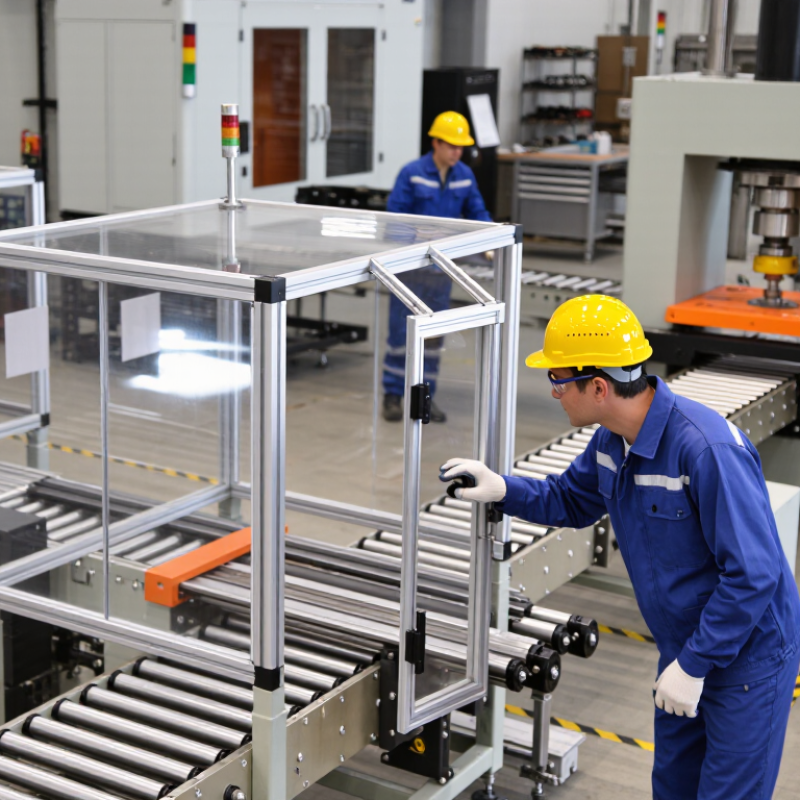
| Welded steel mesh panel | High; allows operators to see through the enclosure | Rigid, durable, and suitable for enclosing many moving or hazardous areas | Hinged access door with a safety interlock; removable panels for infrequent maintenance | Perimeter guarding around production machinery, robots, and material-handling equipment | Mesh opening size and distance from the hazard must be selected to prevent reach-through access. Protect cut edges and damaged coatings from corrosion. |
| Solid steel sheet | Low; blocks the view of the process | Provides a robust barrier and can help contain debris, subject to the machine’s risk assessment and guard design | Hinged or sliding interlocked door where routine access is needed; bolted panel where access is infrequent | Areas with flying chips, sparks, or a need to separate operators from a process | Account for impact loads, ventilation, visibility needs, and the potential for sharp edges. A solid panel is not automatically suitable for containing every type of ejected material. |
| Polycarbonate viewing panel | High when clean and undamaged | Allows process observation without opening the guard; available in configurations suited to machine enclosures | Fixed viewing window, or a hinged interlocked access door where entry is required | Enclosures where operators need to monitor a process while remaining outside the safeguarded area | Choose material thickness and mounting for the foreseeable impact and operating environment. Check chemical compatibility, scratching, aging, and replacement condition. |
| Perforated metal sheet | Moderate; visibility depends on hole size, spacing, and lighting | Rigid metal construction with some airflow through the panel | Interlocked hinged door or a secured removable section for service access | Machine enclosures where airflow is useful and partial visibility is acceptable | Openings must be assessed for reach-through risk and safe distance. Do not assume that airflow openings are safe simply because they are small. |
| Aluminum framing with mesh or clear infill | High with mesh or transparent infill | Modular construction can make layouts and panel replacement easier | Configured with hinged or sliding access doors; use suitable interlocking where required by the risk assessment | Reconfigurable production areas and machinery that may need layout changes | Check frame joints, fasteners, panel retention, and resistance to expected loads. A modular frame still needs secure installation and appropriate guarding dimensions. |
| Stainless steel sheet or mesh | Depends on whether the panel is solid or mesh | Corrosion resistance can be useful in wet or washdown environments | Hinged interlocked door for regular access; sealed or secured removable panels where appropriate | Food, pharmaceutical, or other environments with frequent cleaning, when compatible with the machine and process | Specify a finish and construction compatible with cleaning agents and hygiene requirements. Consider crevices, drainage, and the effects of cleaning on interlock components. |
| Fixed panel with bolted fasteners | Depends on the selected panel material | Simple, secure option for areas that do not require frequent operator access | Use tool-removable fasteners; consider a monitored interlock if the risk assessment requires monitoring when the panel is removed | Infrequently accessed areas, such as service zones or machine sides | Panels should not be routinely removed for production tasks. Plan safe isolation and access procedures for maintenance. |



 Close
Close