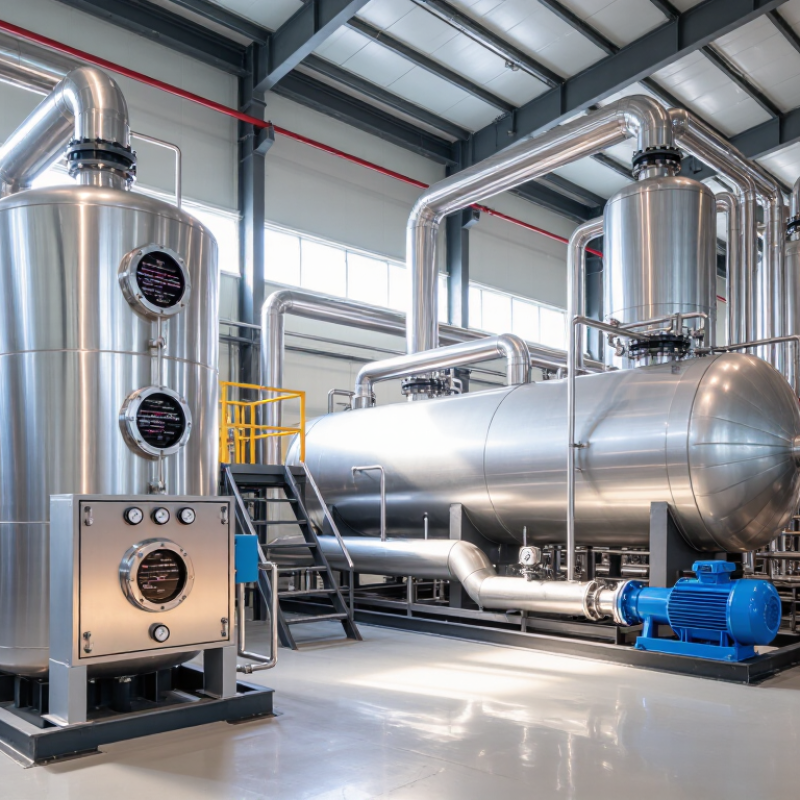
| Triple-Effect Falling-Film Evaporator | 500–10,000 kg/h of water evaporation | 2.4–2.8 | 0.36–0.42 kg steam per kg water evaporated | Forward-feed or backward-feed; suitable for heat-sensitive liquids with short residence time | USD 80,000–250,000 | Product-contact parts commonly 304 or 316L stainless steel; alloy selection depends on chloride and acidity | Heating steam: typically 0.20–0.60 MPa(g); effects commonly operate under progressively deeper vacuum | GB/T 150 or ASME Section VIII, Division 1 |
| Four-Effect Falling-Film Evaporator | 1,000–20,000 kg/h of water evaporation | 3.2–3.8 | 0.26–0.31 kg steam per kg water evaporated | Multiple-effect operation with condensate recovery and inter-effect vapor reuse | USD 120,000–380,000 | 304L or 316L stainless steel; titanium or nickel alloys may be required for aggressive feeds | Heating steam: typically 0.25–0.60 MPa(g); final effect often operates below atmospheric pressure | GB/T 150 / GB/T 151 or ASME VIII / ASME BPE where applicable |
| Five-Effect Falling-Film Evaporator | 2,000–30,000 kg/h of water evaporation | 4.0–5.0 | 0.20–0.25 kg steam per kg water evaporated | High steam-efficiency arrangement for continuous operation and relatively low-viscosity feeds | USD 180,000–550,000 | 316L stainless steel is frequently selected for hygienic or corrosive service | Heating steam: typically 0.30–0.70 MPa(g); vacuum-side design must include external-pressure stability checks | GB/T 150 or ASME Section VIII, Division 1 |
| Six-Effect Falling-Film Evaporator | 3,000–40,000 kg/h of water evaporation | 4.8–5.8 | 0.17–0.21 kg steam per kg water evaporated | Used where steam cost is significant and stable feed conditions permit a larger heat-transfer system | USD 250,000–750,000 | 316L stainless steel for product-contact areas; carbon steel may be used for non-contact utility sections | Steam-side design commonly 0.30–0.80 MPa(g); evaporator bodies may be designed for vacuum service | GB/T 150 / GB/T 151 or ASME VIII / ASME B31.3 for connected piping |
| Mechanical Vapor Recompression Evaporator | 500–50,000 kg/h of water evaporation | Typically 15–35 equivalent steam economy | Low live-steam demand after start-up; electricity is the main operating energy input | Compressor or blower recompresses secondary vapor for reuse as heating vapor | USD 250,000–1,000,000+ | 304L or 316L stainless steel; compressor metallurgy depends on vapor chemistry | Evaporator commonly operates under vacuum; compressor discharge pressure is selected according to the heat-transfer temperature lift | Pressure-vessel code plus electrical and machinery safety requirements |
| Thermal Vapor Recompression with Multiple Effects | 1,000–30,000 kg/h of water evaporation | Approximately 5–8 | Approximately 0.13–0.20 kg live steam per kg water evaporated, depending on ejector design | High-pressure motive steam entrains secondary vapor and increases heating-vapor availability | USD 220,000–800,000 | 316L stainless steel is common for corrosive or sanitary product services | Motive steam pressure is commonly 0.8–2.0 MPa(g); vessel and piping ratings must be verified separately | GB/T 150 or ASME VIII for pressure equipment; piping code selected by project jurisdiction |
| Forced-Circulation Evaporator | 500–25,000 kg/h of water evaporation | 3.0–6.0 in multiple-effect service | Depends on the number of effects, boiling-point elevation, and product concentration | High recirculation velocity reduces tube fouling; suitable for viscous, crystallizing, or fouling liquids | USD 120,000–500,000 | 316L stainless steel, duplex stainless steel, or nickel alloy according to corrosion testing | Heating steam commonly 0.20–0.80 MPa(g); recirculation loop may require a higher mechanical design pressure | GB/T 150 / GB/T 151 or ASME VIII / applicable pump standards |
| Typical GB Compliance Package | Project-dependent | Not applicable | Not applicable | Design review, material certificates, welding procedure qualification, non-destructive testing, pressure testing, and nameplate documentation | Usually included as a compliance scope rather than a separate equipment price | Materials should be traceable to applicable Chinese material standards or approved equivalents | GB/T 150 is commonly used for steel pressure vessels; GB/T 151 is commonly used for shell-and-tube heat exchangers | Confirm TSG 21 and local registration requirements before procurement |
| Typical ASME Compliance Package | Project-dependent | Not applicable | Not applicable | Design calculations, material traceability, qualified welding, inspection and testing, and applicable data reports | Typically adds engineering, inspection, documentation, and authorized-inspection costs | ASME material specifications or accepted equivalents should be identified in the purchase specification | ASME Section VIII, Division 1 is widely used for pressure-vessel design; piping may fall under ASME B31.3 | Verify whether an ASME Code Stamp is required by the end-user or importing jurisdiction |



 Close
Close