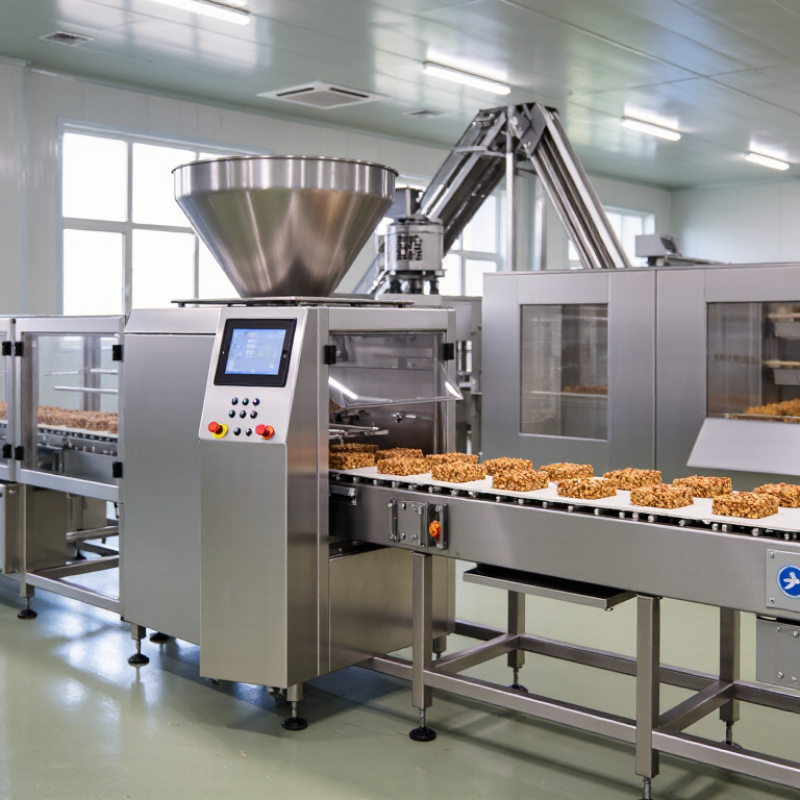
| Batch Mixing Machine | Ingredient blending and syrup distribution | Granola bars, muesli bars, nut bars, fruit-and-cereal bars | 50–500 kg/h | Dry ingredients and heated binders are combined in batches using paddles or horizontal mixing blades. | Small and medium-scale producers, frequent recipe changes, and products with delicate inclusions. | Mixing volume, temperature control, mixer speed, cleanability, and compatibility with sticky binders. |
| Continuous Mixing System | Continuous ingredient blending | High-volume cereal bars with consistent recipes and uniform binder distribution | 300–2,000 kg/h | Metered dry ingredients and liquid binders are continuously fed and mixed at a controlled ratio. | Large factories requiring stable output, reduced manual handling, and repeatable product quality. | Automatic dosing accuracy, feed consistency, recipe control, line synchronization, and maintenance access. |
| Slab Former and Roller | Compression and thickness forming | Pressed granola bars, layered cereal bars, protein-cereal bars, and soft snack slabs | 100–1,500 kg/h | The mixed mass is spread, compressed, and calibrated between rollers to produce a continuous slab. | Manufacturers needing controlled bar thickness, uniform density, and continuous production. | Roller width, adjustable pressure, slab thickness range, product temperature, and anti-stick design. |
| Cereal Bar Guillotine Cutter | Cross-cutting and portioning | Long slab products cut into individual rectangular or square bars | Up to 300 cuts/min | A guillotine knife makes synchronized cross-cuts after the slab has reached the required length and firmness. | Rectangular bars, high-speed lines, and products that require accurate portion length. | Cutting speed, knife material, product temperature, portion tolerance, and crumb control. |
| Longitudinal Slitter | Lengthwise portioning | Multi-lane granola slabs and bars requiring parallel strips before cross-cutting | Typically matched to the forming line | Rotary or fixed blades divide the continuous slab into parallel lanes before final sizing. | Multi-lane production lines and manufacturers seeking higher output from a wide slab. | Number of lanes, lane-width accuracy, blade adjustment, product sticking, and line speed. |
| Cooling Conveyor or Cooling Tunnel | Product setting and temperature reduction | Bars made with heated syrup, chocolate coatings, or soft binders | Determined by conveyor width and line speed | Ambient or conditioned air removes heat so the bars become firm enough for cutting, wrapping, or coating. | Continuous lines where product firmness and dimensional stability are essential. | Cooling length, airflow uniformity, temperature and humidity control, footprint, and energy use. |
| Chocolate Coating and Cooling Line | Enrobing, bottoming, and coating stabilization | Chocolate-coated granola bars, cereal snack bars, and layered coated bars | 100–1,000 kg/h | Bars pass through a chocolate curtain or coating section, followed by controlled cooling and setting. | Premium coated products and producers adding visual appeal or moisture protection. | Coating width, chocolate tempering control, coating thickness, cooling capacity, and cleaning procedures. |
| Automatic Flow-Wrapping Machine | Primary packaging | Individually wrapped cereal, granola, muesli, and energy bars | 80–400 packs/min | Film is formed around each bar, sealed longitudinally and transversely, then discharged as a finished pack. | Retail-ready products requiring consistent pack quality and high packaging efficiency. | Bar dimensions, film type, sealing temperature, modified-atmosphere compatibility, and date coding. |
| Capacity figures are typical planning ranges for general cereal-bar equipment. Actual output depends on recipe viscosity, inclusion size, bar dimensions, moisture content, cooling time, operating speed, and the complete line configuration. |



 Close
Close