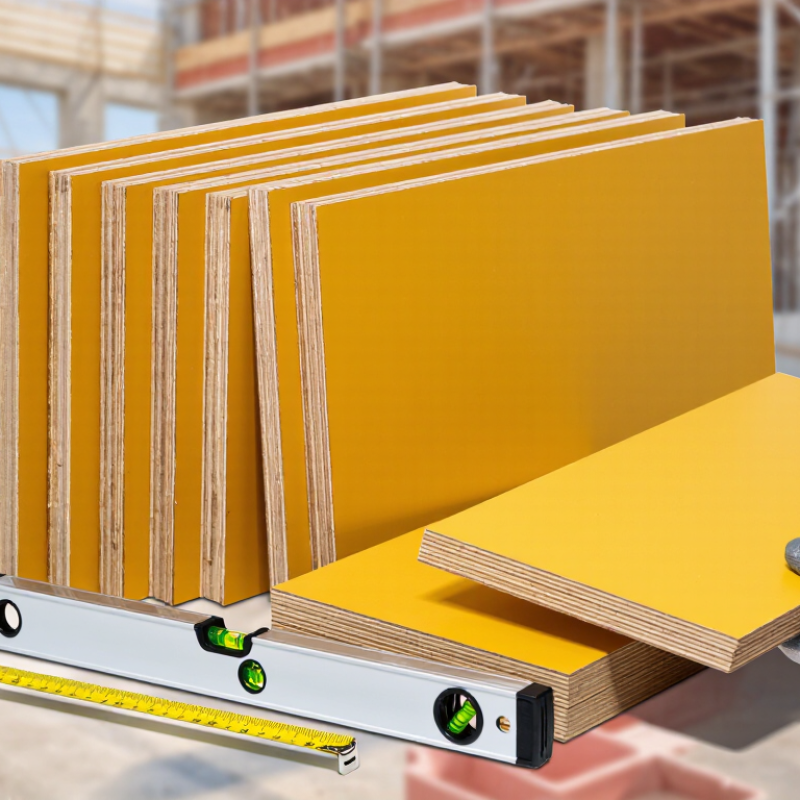
| Product Structure | Panel type | Three-layer structural plywood panel with balanced face, core, and back veneers. Veneer grains are arranged with adjacent layers cross-bonded to improve dimensional stability. | Review production drawings and verify the number and orientation of veneer layers during lay-up. |
| Product Structure | Nominal thickness | 27 mm, with a typical finished thickness tolerance of approximately ±0.5 mm, subject to the agreed product specification. | Measure with a calibrated digital thickness gauge at multiple points on every inspection batch. |
| Product Structure | Common panel dimensions | Typical production sizes include 1,220 × 2,440 mm and 1,250 × 2,500 mm. Custom dimensions may be produced according to the construction project requirements. | Check length, width, squareness, and edge straightness before film application and final packing. |
| Raw Materials | Veneer species | Rotary-cut hardwood or mixed hardwood veneers with uniform thickness, adequate density, and no active decay, insect damage, or excessive loose knots. | Incoming visual grading, veneer thickness measurement, moisture inspection, and rejection of defective sheets. |
| Raw Materials | Veneer moisture content | Typical target range: 8%–14% before adhesive application. The selected range should be compatible with the adhesive system and local climate. | Use a calibrated wood moisture meter; record readings by batch and storage location. |
| Manufacturing Process | Veneer preparation | Veneers are peeled, clipped, dried, graded, and repaired where permitted. Sheets should be flat enough to achieve continuous adhesive contact. | Inspect veneer thickness, surface cleanliness, flatness, defects, and repair quality before gluing. |
| Manufacturing Process | Adhesive system | Exterior-grade phenolic or melamine-urea-formaldehyde adhesive may be used. Adhesive selection must provide moisture-resistant bonding suitable for repeated concrete-forming exposure. | Verify adhesive type, mixing ratio, viscosity, storage life, application rate, and batch traceability. |
| Manufacturing Process | Glue spreading | Uniform adhesive coverage is required on the bonding surfaces. The controlled spread rate is normally established through the adhesive supplier's technical data and production trials. | Check spread rate by weighing test samples and inspect for dry areas, puddling, and uneven application. |
| Manufacturing Process | Lay-up and pre-pressing | The three veneer layers must be aligned, cross-oriented, and pre-pressed sufficiently to prevent shifting, open joints, and edge separation. | Confirm grain direction, panel alignment, joint arrangement, pre-press pressure, and pre-press holding time. |
| Manufacturing Process | Hot pressing | Pressing temperature, pressure, and time are controlled according to the adhesive formulation, veneer moisture, and panel thickness. The full panel must achieve consistent curing. | Record press temperature, pressure, closing time, curing time, and platen condition for each production batch. |
| Surface Treatment | Yellow film facing | Both faces are normally covered with a smooth yellow phenolic film. Common film weights are approximately 120–240 g/m² per face, depending on the required reuse level and surface finish. | Verify film weight, color uniformity, surface cleanliness, film alignment, and absence of wrinkles or blisters. |
| Surface Treatment | Film lamination | The film should be fully bonded to the plywood surface without visible peeling, edge lifting, bubbles, folds, or unbonded areas. | Visual inspection, edge inspection, and periodic adhesion or boiling-water exposure testing according to the agreed test plan. |
| Machining | Edge trimming | Edges should be clean, straight, and free from major splinters, delamination, and missing corners. Cut edges should be sealed when required for enhanced moisture resistance. | Inspect all four edges and use a straightedge and squareness tool for dimensional verification. |
| Dimensional Control | Length and width tolerance | Typical commercial tolerance is approximately ±1 mm for standard panel dimensions, unless a project-specific tolerance is agreed. | Measure with a calibrated steel tape or digital measuring system at final inspection. |
| Dimensional Control | Squareness and diagonal difference | The panel should remain square, with the difference between the two diagonals commonly controlled to approximately 2 mm or less for standard-size panels. | Measure both diagonals and compare the result with the approved inspection specification. |
| Physical Properties | Finished-panel moisture content | Typical release range: 8%–14%, with no localized wet areas or abnormal moisture gradients. | Take readings at the face, center area, and edges of sampled panels. |
| Physical Properties | Density consistency | The panel should have uniform density without large resin pockets, hollow areas, severely compressed zones, or visibly weak core sections. Density is commonly evaluated by batch rather than by a single universal value. | Determine density from panel mass and volume on sampled units; combine with visual and internal-bond inspection. |
| Bonding Quality | Bonding classification | For exterior formwork exposure, the bonding performance should be suitable for exterior-use plywood. EN 314-2 Class 3 is a commonly referenced bonding classification where applicable. | Conduct glue-line shear testing according to EN 314-1 and evaluate against the applicable requirements of EN 314-2 or the project standard. |
| Bonding Quality | Delamination resistance | No significant glue-line opening, veneer separation, or film lifting should occur after the specified water-resistance test. | Use boiling-water or cyclic water-exposure testing according to the selected standard and approved inspection plan. |
| Mechanical Quality | Bending performance | Bending strength and modulus depend on veneer species, grain direction, density, and construction. Values should be confirmed by a laboratory test report rather than assumed from thickness alone. | Perform bending tests in the principal directions using EN 310, ASTM D3043, or another contractually agreed method. |
| Surface Quality | Concrete-facing surface | The yellow film should be smooth and continuous, without visible pinholes, deep scratches, contamination, open film joints, or areas likely to imprint on concrete. | Inspect under consistent lighting before packing; classify defects according to approved visual samples. |
| Chemical Safety | Formaldehyde emission | For markets requiring an E1 classification, formaldehyde emissions should comply with the applicable limit, commonly assessed by EN 717-1. The declared class must be supported by a valid test report. | Use periodic third-party or in-house laboratory testing with traceable samples from production batches. |
| Quality Inspection | Sampling plan | A practical inspection plan includes 100% visual inspection for major surface and edge defects, with dimensional and performance tests performed on representative samples. | Apply an agreed AQL or project-specific sampling plan; retain inspection records and test specimens. |
| Traceability | Batch identification | Each production batch should be traceable to veneer preparation, adhesive batch, pressing cycle, film batch, inspection results, and packing date. | Use batch numbers on inspection records, labels, pallets, and quality certificates. |
| Packaging | Pallet protection | Panels should be stacked on level supports, protected from direct rain and ground moisture, and secured to prevent edge damage, sliding, and excessive bending during transport. | Inspect pallet alignment, protective wrapping, corner protection, strapping, labels, and loading condition. |
| Storage and Use | Recommended storage condition | Store horizontally on level supports in a covered, ventilated area. Avoid direct sunlight, standing water, and rapid changes in temperature or humidity. | Check warehouse conditions and confirm that panels are not stored directly on the floor or exposed to weather. |
| Compliance | Reference standards | Common reference documents include EN 636 for plywood performance, EN 314-1 and EN 314-2 for bonding quality, EN 310 for bending properties, EN 322 for moisture content, EN 315 for dimensional tolerances, and EN 717-1 for formaldehyde emission testing. | The applicable standard, edition, test frequency, and acceptance limits should be stated in the purchase specification or quality agreement. |
| Release Criteria | Final acceptance | Accept: correct thickness and dimensions, sound three-layer construction, fully bonded film, acceptable appearance, compliant moisture content, satisfactory test results, and complete traceability documentation. | Quality manager approval based on final inspection records, laboratory results, and customer-specific requirements. |



 Close
Close