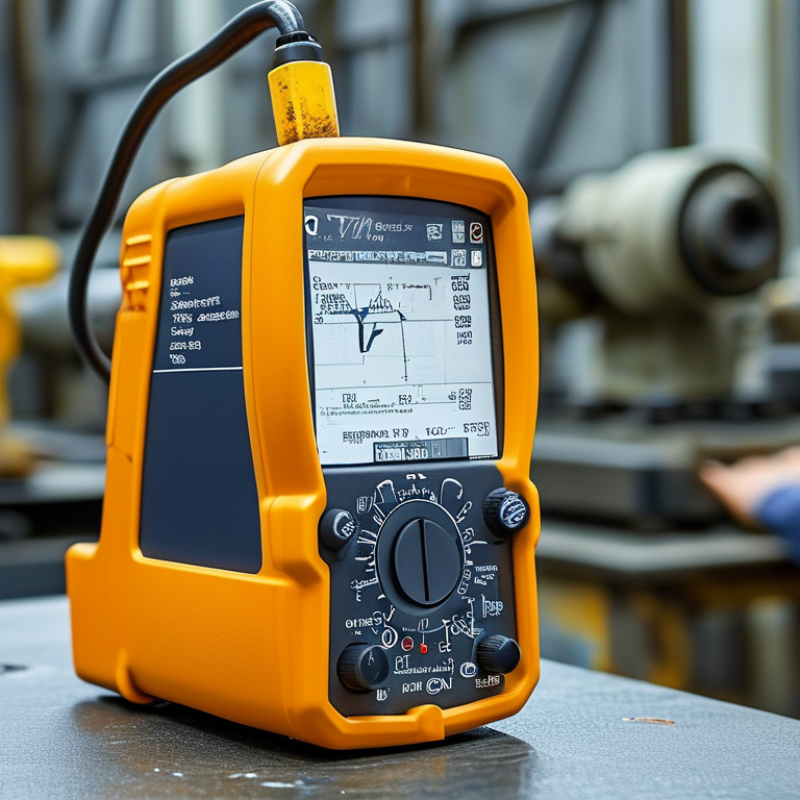
Meter 01
General-Purpose RMS Tester | Digital processing of accelerometer signals | Velocity RMS, acceleration RMS, displacement peak-to-peak | 10 Hz–1 kHz for velocity; 10 Hz–10 kHz for acceleration | 0.1–199.9 mm/s RMS | Typically ±5% of reading | External magnetic or stud-mounted sensor | Backlit numeric display; maximum-value hold; manual readings | Routine checks on motors, pumps, fans, gearboxes, and compressors |
Meter 02
Four-Channel Route Meter | Multi-channel piezoelectric measurement | Velocity RMS, acceleration RMS, crest factor, temperature | 2 Hz–10 kHz, dependent on sensor and filter selection | 0.01–200 mm/s RMS | Typically ±3% of reading | One triaxial or up to four single-axis sensors | Color display; route-based data logging; USB export; alarm levels | Condition-monitoring routes across multiple rotating assets |
Meter 03
Portable FFT Analyzer | Time-domain sampling with fast Fourier transform analysis | Velocity RMS, acceleration RMS, displacement, FFT spectrum | DC–20 kHz, with selectable analysis bandwidth | 0.01–100 mm/s RMS | Typically ±2% of full scale | ICP-compatible accelerometer; magnetic base recommended | High-resolution spectrum; waveform capture; internal memory; software export | Fault diagnosis involving imbalance, misalignment, looseness, and bearing activity |
Meter 04
Compact Vibration and Temperature Meter | Handheld accelerometer measurement with integrated infrared temperature sensing | Velocity RMS, acceleration RMS, surface temperature | 10 Hz–1 kHz for velocity; 10 Hz–10 kHz for acceleration | 0.1–199.9 mm/s RMS | Typically ±5% of reading | Built-in contact sensor or external probe | Large LCD; peak hold; automatic shutdown; no continuous route database | Fast inspection of accessible bearings and housings during maintenance rounds |
Meter 05
Wireless Triaxial Monitor | Battery-powered MEMS or piezoelectric triaxial sensing | Velocity RMS, acceleration RMS, displacement, temperature | 1 Hz–5 kHz, depending on sampling mode | 0.01–100 mm/s RMS | Typically ±5% of reading | Integrated triaxial sensor with magnetic mounting option | Wireless gateway connection; trend storage; configurable alerts | Continuous or periodic monitoring where wired access is difficult |
Meter 06
Intrinsically Safe Inspection Meter | Contact accelerometer measurement with protected electronics | Velocity RMS, acceleration RMS, displacement peak-to-peak | 10 Hz–1 kHz for velocity; 10 Hz–5 kHz for acceleration | 0.1–100 mm/s RMS | Typically ±5% of reading | External sensor; hazardous-area approval must match the work zone | Backlit display; peak hold; limited internal storage | Inspection work in classified areas when the specific approval is suitable |
Meter 07
Balancing and Phase Meter | Dual-channel vibration and phase-reference measurement | Velocity RMS, acceleration RMS, phase angle, tachometer speed | 2 Hz–10 kHz; phase tracking typically up to 10,000 rpm | 0.01–200 mm/s RMS | Typically ±3% of reading; phase accuracy commonly within ±2° | Two accelerometers plus optical or magnetic tachometer | Color display; balancing calculations; spectrum and phase storage | Field balancing, resonance checks, and rotating-equipment troubleshooting |
| ISO 20816-3 interpretation: Overall vibration velocity is normally evaluated as RMS in mm/s. The 2.8–7.1 mm/s RMS interval is commonly associated with the B/C and C/D boundary values for applicable rotating-machine groups, but the correct severity zone depends on machine size, support stiffness, rated speed, measurement position, and the applicable ISO 20816-3 evaluation criteria. |
| Measurement note: Accuracy, frequency response, ingress protection, hazardous-area approval, and sensor compatibility vary by instrument configuration. Confirm the manufacturer’s technical documentation and calibration status before using any meter for acceptance testing or compliance decisions. |



 Close
Close