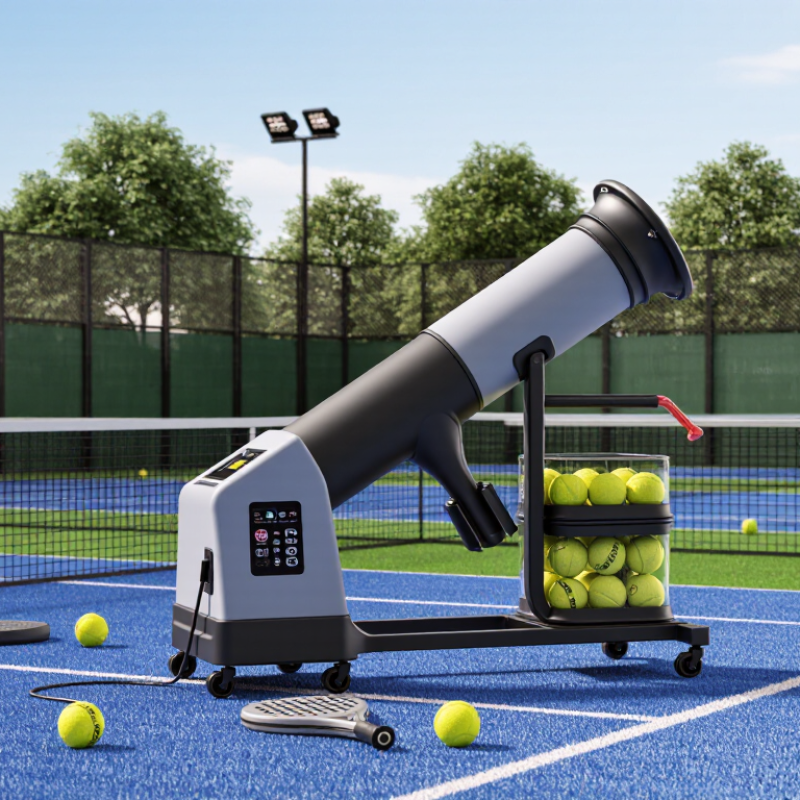
| Basic Portable Feeder | Repetition of forehands, backhands, volleys, and simple overheads | Approximately 30–55 km/h | Approximately 80–120 balls | Approximately 2–4 hours | ★★★★★
Usually lightweight and easy to transport | Adjustable feed interval, elevation control, rechargeable battery, and stable wheels or handles |
| Intermediate Oscillating Machine | Cross-court consistency, movement, and alternating shot practice | Approximately 35–70 km/h | Approximately 100–150 balls | Approximately 3–5 hours | ★★★★☆
Portable, but generally heavier | Horizontal oscillation, variable speed, programmable feed frequency, and remote control |
| Advanced Programmable Machine | Structured drills, tactical patterns, and match-specific sequences | Approximately 40–85 km/h | Approximately 120–180 balls | Approximately 3–6 hours | ★★★☆☆
Often requires two-person handling | Multi-step drills, randomization, spin settings, speed memory, and app or remote programming |
| High-Speed Performance Unit | Advanced reaction training, fast volleys, and overhead preparation | Approximately 60–110 km/h | Approximately 120–200 balls | Approximately 2–5 hours | ★★★☆☆
Performance-focused rather than ultra-light | High-speed adjustment, consistent launch angle, strong frame, emergency stop, and accurate ball delivery |
| Spin-Capable Training Machine | Topspin, slice, defensive lobs, and handling varied ball trajectories | Approximately 30–90 km/h | Approximately 100–180 balls | Approximately 3–6 hours | ★★★☆☆
Weight depends on the spin mechanism | Independent speed and spin controls, repeatable trajectory, feed consistency, and simple calibration |
| Club-Level Heavy-Duty Unit | Frequent group sessions, coaching programs, and high training volume | Approximately 40–100 km/h | Approximately 150–250 balls | Approximately 4–8 hours | ★★☆☆☆
Designed for durability and repeated use | Large hopper, replaceable parts, robust wheels, quick charging, duty-cycle rating, and service access |



 Close
Close