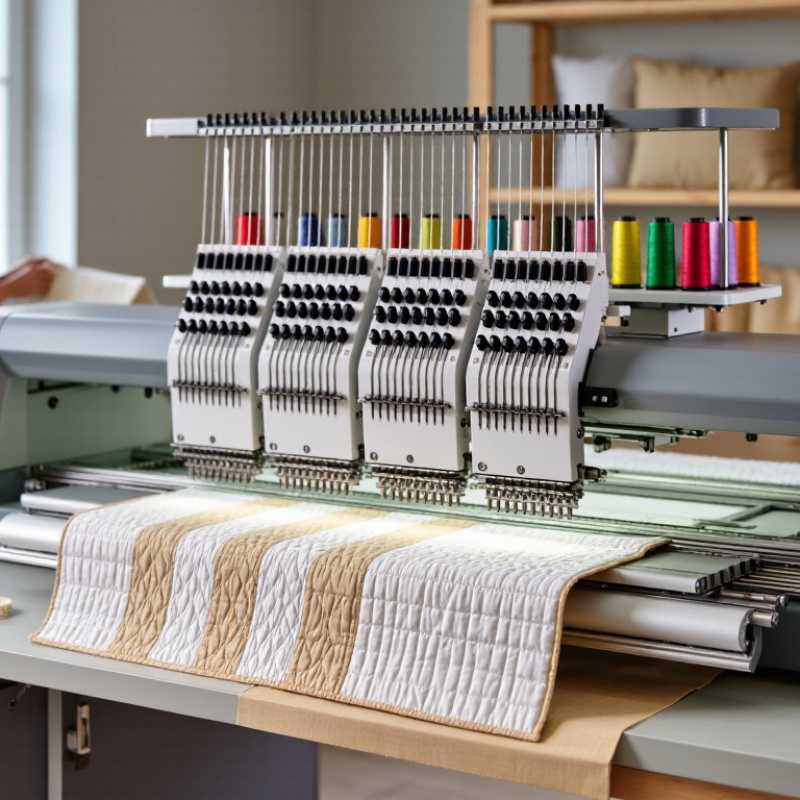
| Needle Configuration | Two or more needles mounted in a fixed or electronically controlled needle bar. Needle quantity and spacing depend on the machine configuration. | The main drive synchronizes the needle bar, rotary hook, presser foot, and fabric-feeding system. Each needle forms a stitch using its own thread path and bobbin interaction. | Multiple parallel stitch lines can be produced in one machine pass, reducing repeated setup and alignment work. |
| Needle Gauge | The distance between neighboring needles is commonly specified in millimetres or inches. 25.4 mm (1 inch) is a common quilting reference, although other gauges are available. | The programmed pattern is mapped to the physical distance between needles. The control system adjusts movement and pattern placement according to the selected gauge. | Consistent spacing is maintained across repeated quilting rows and geometric designs. |
| Stitch-Length Control | Many computerized quilting systems provide a programmable stitch length of approximately 0–12 mm; the usable range varies by machine and fabric. | A controller calculates fabric movement between needle penetrations. Servo or stepper motors coordinate the X-axis, Y-axis, and needle motion to maintain the selected stitch length. | The machine can produce more uniform stitches during straight lines, curves, and changes in sewing speed. |
| Operating Speed | Industrial quilting machines commonly operate within a manufacturer-defined range that may reach approximately 800–2,000 stitches per minute, depending on material, pattern, and needle count. | Electronic speed control regulates motor acceleration and deceleration. The system can reduce speed automatically at corners, pattern changes, or areas requiring greater control. | Higher production throughput is possible while controlled acceleration helps reduce skipped stitches and thread breakage. |
| Pattern Storage | Patterns may be saved as built-in designs or imported digital files. Storage capacity depends on the controller, file format, and available memory. | The computer converts digital vector or stitch data into coordinated motor commands. Operators can select, scale, mirror, rotate, or repeat compatible designs. | Frequently used designs can be reproduced with less manual marking and improved repeatability. |
| Pattern Repeat | Repeatable borders, blocks, rows, and all-over patterns can be programmed. The maximum repeat area is limited by the frame, throat space, and software. | The controller calculates the next pattern position and maintains registration between adjacent repeats using programmed offsets. | Large quilt surfaces can be covered with consistent motifs and fewer manual measurements. |
| Fabric Feeding | Common systems use synchronized rollers, a frame, a conveyor-style feed, or a combination of these methods. | Encoders and drive motors monitor fabric movement. The control unit coordinates feed speed with needle penetration and stitch timing. | Layer movement is more controlled, helping maintain pattern accuracy across batting, backing, and face fabric. |
| Needle and Hook Timing | Timing is electronically synchronized with the main shaft. Correct timing is essential for loop formation and reliable bobbin pickup. | Position sensors report shaft location to the controller. The system coordinates the needle eye, thread loop, rotary hook, and take-up mechanism during every stitch cycle. | Accurate timing helps reduce skipped stitches, thread nests, and uneven stitch formation. |
| Thread Tension Management | Most machines use individually adjustable upper-thread tension for each needle, combined with mechanically adjusted bobbin tension. | Operators balance the upper and lower thread paths according to thread size, fabric thickness, batting loft, and stitch density. Some systems provide tension monitoring or alerts. | Independent adjustment supports balanced stitches when several thread colors or thread types are used at the same time. |
| Thread-Break Detection | Optical, mechanical, or electronic sensors may monitor thread movement on individual needle channels. | When a sensor detects missing thread movement or an abnormal thread condition, the controller can stop the machine and display an alert. | Faults can be corrected earlier, reducing defective sections and unnecessary material waste. |
| Needle Selection | Depending on the design, all installed needles may run together, or selected needle positions may be enabled or disabled through the control panel. | The software assigns pattern elements to specific needle channels and sends synchronized activation commands to the drive system. | Different stitch layouts and multi-colour effects can be created without changing the complete needle assembly. |
| User Interface | Typical controls include a touch display or digital panel for speed, stitch length, pattern selection, needle status, alarms, and machine positioning. | The interface converts operator settings into parameters for the motion controller, motor drives, sensors, and pattern-processing software. | Digital settings improve repeatability and reduce dependence on manual calculations. |
| Frame and Working Area | The usable quilting width depends on throat space, frame length, roller arrangement, and machine design. It is normally specified in millimetres or inches. | The software limits or maps the design to the available working envelope and may provide boundary checks before sewing begins. | Operators can plan pattern size and placement more accurately before production starts. |
| Material Compatibility | Suitable materials commonly include woven cotton, polyester blends, batting, and quilted layered assemblies. Maximum thickness varies by presser-foot lift and machine design. | Needle size, thread type, presser-foot pressure, feed settings, and sewing speed are adjusted to the material stack. | Correct parameter selection improves stitch formation and helps protect delicate or bulky quilt layers. |
| Production Advantage | One pass can create multiple parallel rows, while digital pattern control supports repeatable output. | The computer coordinates needle motion, fabric transport, pattern positioning, speed, and machine alarms as one integrated process. | Compared with manually operated single-needle workflows, the system can reduce alignment time, improve consistency, and increase production efficiency. |



 Close
Close