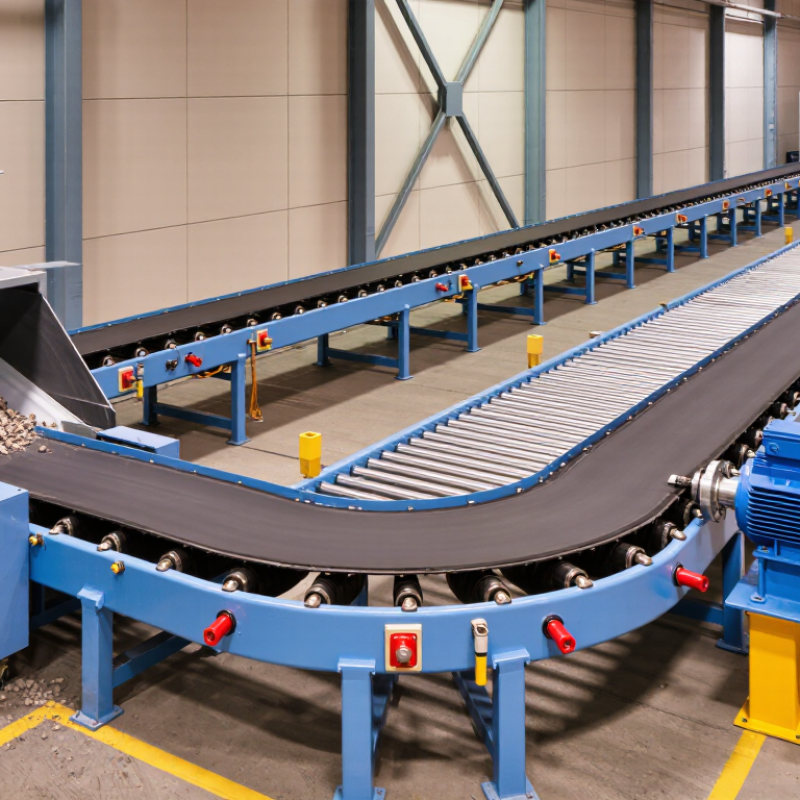
| Basic Definition | A belt conveyor is a mechanical handling system that continuously transports materials on a moving belt. | An endless belt travels around rotating pulleys while carrying materials from one point to another. | It can move packaged goods, bulk solids, containers, components, and other materials over short or long distances. |
| Conveyor Belt | The flexible carrying surface that supports and moves the transported material. | The belt receives motion from the drive pulley and returns along the lower side of the conveyor frame. | Common belt materials include rubber, PVC, polyurethane, and fabric-reinforced elastomers. Material selection depends on temperature, abrasion, oil, food-contact, and chemical requirements. |
| Drive Pulley | The powered pulley that transfers rotational force to the belt. | An electric motor and gearbox rotate the pulley; friction between the pulley surface and belt produces belt movement. | Drive pulleys are commonly located at the discharge end, although the arrangement can vary by conveyor design. |
| Head Pulley | The pulley positioned near the material discharge point. | As the belt passes around the head pulley, the conveyed material leaves the belt and falls or transfers to the next process. | The head pulley may also serve as the drive pulley in many conveyor arrangements. |
| Tail Pulley | The pulley located at the loading or return end of the conveyor. | It guides the belt back toward the loading area and helps maintain the belt loop. | Some designs use an adjustable tail pulley to assist with belt tracking and tensioning. |
| Idler Rollers | Unpowered rollers that support the belt and its load. | They rotate as the belt passes over them, reducing sag and rolling resistance. | Carrying idlers support the loaded section; return idlers support the empty belt on its underside. |
| Carrying Idler Arrangement | The roller configuration beneath the loaded carrying side of the belt. | Flat idlers support a flat belt, while troughed idlers form a shallow channel that helps retain bulk material. | Typical trough angles include approximately 20, 35, or 45 degrees, depending on the design and material-handling requirements. |
| Conveyor Frame | The structural framework that supports pulleys, idlers, the belt, and protective components. | It maintains alignment and provides the required elevation, length, and support for the conveyor route. | Frames may be constructed from steel, stainless steel, or aluminum, depending on load, environment, hygiene, and corrosion requirements. |
| Motor and Gearbox | The power unit that supplies controlled rotational force to the drive pulley. | The motor produces rotation, while the gearbox generally reduces speed and increases usable torque at the drive pulley. | Required power depends on belt speed, conveyor length, incline, material mass, friction, acceleration, and operating duty. |
| Belt Tensioning System | A mechanism that maintains suitable tension in the belt. | Take-up devices compensate for belt stretch and help preserve contact between the belt and drive pulley. | Common approaches include screw take-ups, gravity take-ups, and automatic tensioning systems. |
| Belt Tracking | The process of keeping the belt centered along the conveyor structure. | Correct pulley alignment, idler positioning, belt tension, and tracking devices help prevent sideways belt movement. | Poor tracking can cause edge damage, material spillage, increased wear, and unplanned downtime. |
| Loading Zone | The area where material is placed onto the moving belt. | Chutes, hoppers, skirts, and impact idlers control the material flow and reduce the force of falling material. | Proper loading should be centered, steady, and aligned with the belt direction to minimize spillage and belt damage. |
| Discharge Zone | The area where material leaves the conveyor. | Material typically discharges at the head pulley or transfers to another conveyor, screen, bin, or processing machine. | Discharge behavior depends on belt speed, pulley diameter, material properties, and the transfer-point design. |
| Belt Speed | The linear speed at which the belt travels. | Speed is controlled by the drive system and determines how quickly material moves through the conveying route. | Many industrial conveyors operate at speeds ranging from below 0.5 m/s to several meters per second; the correct value depends on the material and application. |
| Load Capacity | The amount of material the conveyor can transport safely and continuously. | Capacity is influenced by belt width, belt speed, material density, cross-sectional loading, incline, and equipment design. | Capacity is commonly expressed in tonnes per hour for bulk materials or units per minute for packaged products. |
| Belt Width | The usable transverse width of the conveyor belt. | A wider belt can carry a larger cross-sectional load or provide more space for individual products. | Typical industrial belt widths vary from narrow belts used for small products to wide belts used for heavy bulk handling. |
| Incline and Decline Operation | The ability to transport material upward or downward between different elevations. | Inclined conveyors use belt friction, suitable loading, and sometimes cleats or raised profiles to reduce sliding. | The allowable angle depends on belt surface, material shape, moisture, particle size, and whether the material is packaged or loose. |
| Cleated Belt | A belt fitted with raised transverse profiles or cleats. | The cleats help retain products or bulk material when the conveyor operates on an incline or decline. | Cleat height and spacing should match the material characteristics and the required conveying angle. |
| Skirt Boards | Sealing plates installed along the sides of a loading area. | They contain material during transfer and reduce spillage before the load becomes evenly distributed on the belt. | Skirt contact should be adjusted carefully because excessive pressure can increase belt wear and drive resistance. |
| Safety Features | Devices and guards designed to reduce operational risks. | Emergency pull cords, guards, interlocks, alarms, and accessible stop controls allow the conveyor to be stopped or isolated during unsafe conditions. | Safety provisions should follow applicable workplace regulations, risk assessments, and site-specific procedures. |
| Energy Use | The electrical power required to operate the conveyor. | Energy is mainly used to overcome belt and idler resistance, lift material, accelerate the load, and overcome friction in the drive system. | Efficient loading, correct belt tension, aligned components, and properly maintained rollers can reduce energy consumption. |
| Routine Maintenance | Inspection and servicing activities used to keep the conveyor reliable. | Operators inspect belt condition, tracking, pulley lagging, idlers, fasteners, drive components, guards, and emergency-stop devices. | Maintenance intervals depend on operating hours, load, dust, moisture, temperature, material abrasiveness, and manufacturer specifications. |
| Primary Advantages | The operational benefits of belt conveying equipment. | Continuous belt movement provides a controlled path for transporting materials between processes. | Advantages commonly include continuous operation, relatively low noise, adaptable layouts, gentle product handling, and suitability for automation. |
| Common Limitations | Conditions that may restrict conveyor performance. | Material properties, excessive incline, poor loading, belt misalignment, or unsuitable environmental conditions can reduce performance. | Potential issues include belt wear, spillage, carryback, product degradation, limited flexibility around obstacles, and the need for regular maintenance. |



 Close
Close