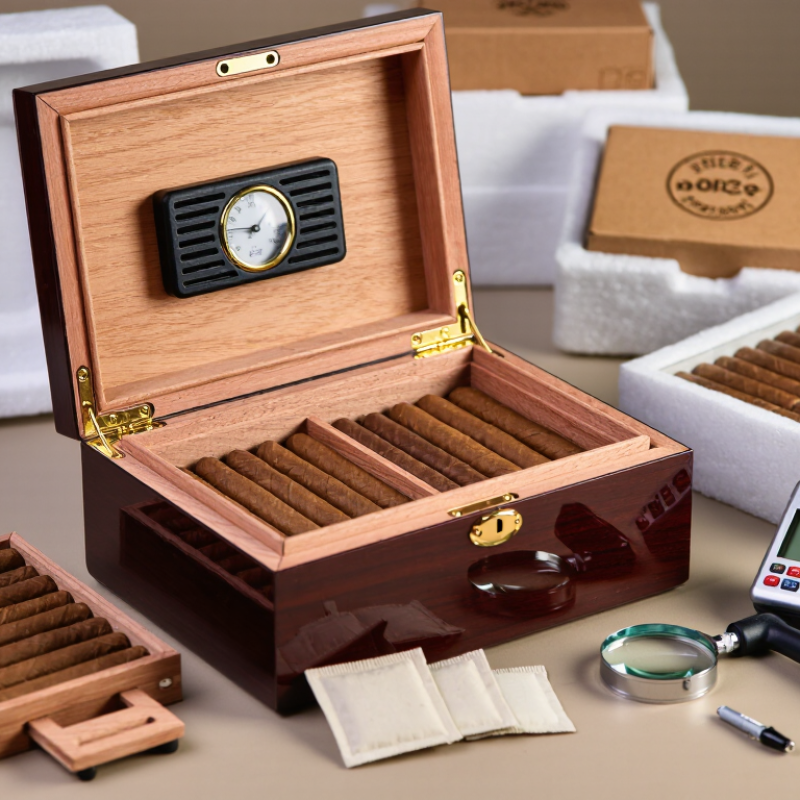
| Storage Capacity | Common commercial sizes range from 25 to 150 cigars, depending on interior layout and cigar ring gauge. | Offer at least three capacity options, such as 25, 50, and 100 cigars, to cover different retail price points. | Check the internal dimensions and test the box with the intended cigar sizes, including Churchill and Toro formats. | Capacity affects carton dimensions, freight cost, shelf placement, and product positioning. | Removable traysDivider layoutAccessory compartment |
| Interior Wood | Spanish cedar is widely used because it supports aroma protection, moisture buffering, and resistance to common tobacco pests. | Use kiln-dried, odor-controlled cedar with consistent thickness and smooth, splinter-free surfaces. | Request wood species confirmation, thickness records, moisture data, and a physical sample before bulk production. | Wood species and treatment records help support material traceability and reduce odor or contamination risks. | Cedar liningWood stainLaser engraving |
| Humidity Operating Range | A practical cigar-storage target is generally 65%–72% relative humidity, depending on cigar type and user preference. | Design the box for stable humidity retention rather than claiming one universal humidity level. | Conduct a sealed-box test with a calibrated hygrometer under controlled room conditions for at least 48 hours. | Clear humidity guidance reduces misuse, customer complaints, and product-return risk. | Humidity guideDigital hygrometerHumidifier tray |
| Hygrometer Accuracy | For consumer humidors, a practical target is approximately ±2% to ±3% RH within the specified operating range. | Use a calibrated digital unit with replaceable batteries and a clearly stated measurement range. | Compare readings against a reference instrument or perform a salt-test verification before shipment. | Accurate readings help prevent over-humidification, mold growth, wrapper damage, and customer dissatisfaction. | Dial gaugeLCD displayBranded dial face |
| Seal and Lid Fit | The lid should close evenly around the full perimeter with no visible gaps, twisting, or loose hinges. | Use a continuous compression seal or precisely fitted wood-to-wood closure with stable hinge alignment. | Perform a paper-strip test around the lid and inspect the seal after repeated opening and closing cycles. | A reliable seal is essential for humidity retention and long-term product performance. | Magnetic closureBrass hardwareSoft gasket |
| Seasoning Requirement | New wooden humidors commonly require approximately 7–14 days of conditioning before regular use. | Supply a written seasoning procedure and specify whether the unit is shipped dry, pre-conditioned, or ready to use. | Review the instruction sheet and test moisture stability after conditioning according to the stated procedure. | Correct instructions reduce warranty claims caused by cracked wood, unstable humidity, or incorrect setup. | Printed guideQR instructionsPre-seasoning service |
| Wood Moisture Control | Wood should be properly kiln-dried and free from excessive residual moisture, surface mold, and strong chemical odor. | Set a documented incoming-material moisture specification appropriate for the selected wood and production environment. | Use a calibrated wood moisture meter and maintain batch inspection records. | Moisture control supports dimensional stability, reduces warping, and improves consistency between batches. | Material certificateBatch codingInspection report |
| Finish and Coating | The exterior finish should be even, cured, scratch-resistant, and free from sticky surfaces, peeling, or strong residual odor. | Use a coating system suitable for consumer wood products and keep the interior free from unsuitable finishes. | Inspect gloss consistency, adhesion, odor, cure time, and surface defects on production samples. | Coating selection can affect chemical safety, odor transfer, appearance, and import documentation. | Matte finishGloss finishNatural wood finish |
| Packaging Protection | Packaging should protect corners, hinges, glass, and finished surfaces during stacking and international transport. | Use a fitted protective insert, moisture-resistant outer carton, and drop-tested packaging configuration. | Review carton dimensions, compression strength, drop-test results, and packing photographs. | Improved packaging reduces transit damage, replacement costs, and retail presentation issues. | Custom insertGift boxRetail sleeve |
| Product Safety Documentation | Documentation should identify materials, coatings, hardware, packaging, and any included electronic components. | Maintain a technical file containing specifications, inspection records, test reports, and user instructions. | Request documents before purchase order approval and confirm that they match the final production configuration. | Requirements vary by destination and product configuration; documentation supports customs and market compliance reviews. | Technical fileMaterial declarationUser manual |
| Brand Customization | Common methods include laser engraving, screen printing, metal plaques, printed packaging, and custom color matching. | Use a documented approval process for artwork, color, placement, dimensions, and production samples. | Approve a pre-production sample or digital proof before mass production. | Clear artwork control prevents costly rework and protects consistency across retail channels. | Logo engravingMetal badgeCustom carton |
| Quality-Control Plan | Inspection should cover dimensions, wood defects, finish, hardware, seal, humidity accessories, packaging, and labeling. | Use first-article approval, in-process inspection, and final random inspection based on an agreed sampling plan. | Require a written checklist, defect photos, sample size, acceptance criteria, and corrective-action records. | Documented quality control improves batch consistency and provides evidence when resolving claims. | Inspection checklistPhoto reportAQL-based inspection |
| Commercial Selection Score | Recommended evaluation weighting: 30% humidity performance, 25% construction, 20% finish, 15% documentation, and 10% customization. | Prioritize functional stability before appearance or low purchase price. | Score each supplier sample using the same weighted checklist and record pass/fail results. | A weighted method helps wholesale buyers compare products objectively across different quotations. | Buyer scorecardSample comparisonSupplier audit |



 Close
Close