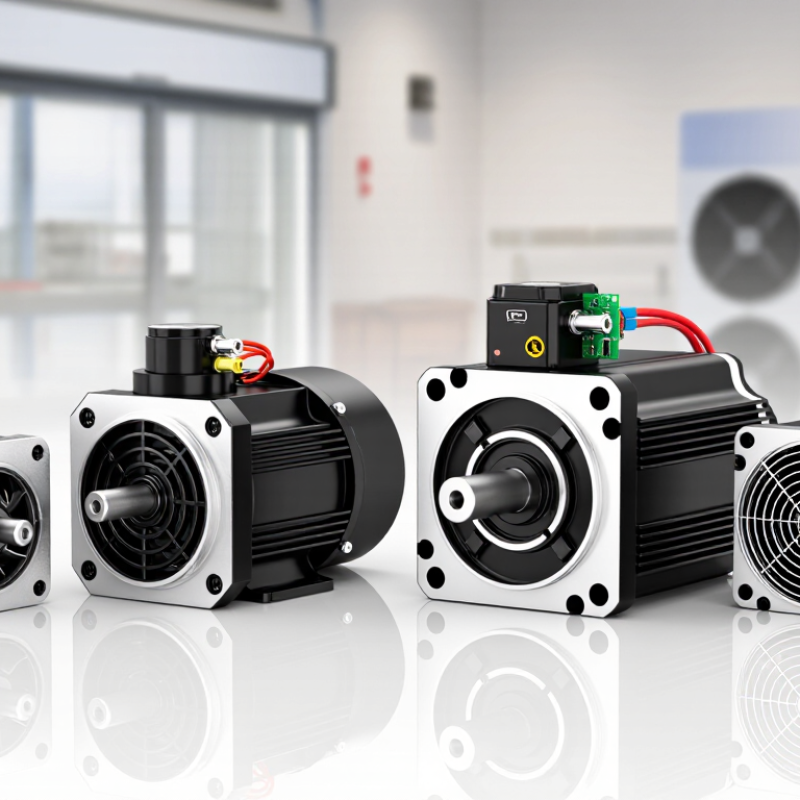
| Motor Technology Comparison |
| Shaded-Pole AC Motor | Small evaporator, condenser, and cabinet fans where low cost and simple operation are priorities. | Commonly single-phase AC; approximately 2–6 poles and fixed speeds from about 1,300 to 3,000 rpm, depending on frequency and pole count. | Low
Usually less efficient than PSC, BLDC, and EC designs at comparable airflow. | Normally fixed speed. Airflow is adjusted by blade design, voltage variation, or mechanical selection; wide-range electronic control is generally unsuitable. | Simple construction, low initial cost, easy sourcing, and no external electronic controller required. | Higher heat generation, lower efficiency, limited controllability, and greater sensitivity to voltage and thermal conditions. | Confirm thermal protection, locked-rotor behavior, rated frequency, ambient temperature, insulation system, and required safety approvals for the destination market. |
| Permanent-Split Capacitor (PSC) AC Motor | Commercial refrigeration evaporators, condensing units, display cases, walk-in coolers, and air-cooled heat exchangers. | Single-phase AC; commonly 4–6 poles with operating speeds typically around 900–1,800 rpm at 50/60 Hz. | Medium
Generally more efficient and quieter than shaded-pole designs of similar output. | Fixed speed or limited voltage-controlled operation. Capacitor value and fan load must match the motor design. | Good balance of price, reliability, noise, starting performance, and global availability. | Requires a correctly rated run capacitor; efficiency and speed can decline if the capacitor, voltage, or load is outside specification. | Specify capacitor type and tolerance, rotation direction, voltage range, frequency, rated current, permissible speed-control method, and replacement availability. |
| Electronically Commutated (EC) Motor | Energy-efficient evaporator, condenser, and electronically controlled refrigeration systems, including variable-airflow applications. | Usually single-phase AC input with integrated electronics; commonly available across 50/60 Hz systems, with speed ranges often approximately 500–2,500 rpm. | High
Often substantially more efficient at part load than fixed-speed AC motors, subject to design and operating point. | Integrated electronic commutation; speed may be controlled through a dedicated control input, PWM, 0–10 V signal, or another specified interface. | Low energy consumption, stable performance over a broad operating range, improved airflow control, and reduced system heat. | Higher purchase cost, electronic component exposure, possible electromagnetic compatibility requirements, and greater sensitivity to surge or wiring errors. | Verify input-voltage range, control signal, minimum speed, fault output, surge immunity, EMC documentation, harmonic behavior, and replacement-program continuity. |
| Brushless DC (BLDC) Motor | Compact refrigeration fans, battery-supported equipment, inverter-based systems, and applications requiring precise speed control. | Typically supplied by low-voltage DC or through an integrated AC-to-DC driver; speed is application-specific and often controlled electronically. | High
High efficiency is possible, particularly across variable-speed and part-load operation. | Excellent variable-speed capability through PWM, analog input, digital control, or internal control logic, depending on the design. | High controllability, compact size, low maintenance, good part-load efficiency, and useful diagnostic functions. | Requires compatible electronics, defined control logic, and protection against incorrect polarity, overvoltage, and electrical transients. | Confirm DC bus voltage, connector pinout, controller compatibility, startup behavior, stall protection, communication protocol, and service replacement procedure. |
| Three-Phase Induction Motor | Large condenser fans, industrial refrigeration, cold storage, process cooling, and systems with an available three-phase supply. | Three-phase AC; commonly 2–8 poles, with speeds typically from approximately 700 to 3,600 rpm depending on pole count and frequency. | Medium to High
Performance depends on motor size, load point, power quality, and whether a variable-frequency drive is used. | Fixed speed across direct-on-line operation; variable speed is available with a properly selected variable-frequency drive. | Robust construction, good industrial durability, broad power range, and suitability for continuous-duty applications. | Usually larger and heavier than small single-phase fan motors; requires phase protection and careful drive compatibility when speed control is used. | Check phase sequence, voltage imbalance limits, starting current, service factor, drive requirements, bearing arrangement, enclosure rating, and local electrical installation rules. |
| Performance, Compliance, and Supply-Chain Checks |
| Airflow and Pressure Verification | Require a fan performance curve showing airflow against static pressure, rather than selecting a motor by rated wattage alone. | Compare duty-point airflow, pressure, input power, motor temperature, noise, and efficiency under the actual fan blade and guard configuration. | Request test conditions, air-density assumptions, measurement tolerance, rotation direction, and whether the curve represents a complete fan assembly or the motor alone. |
| Temperature and Duty Rating | Confirm ambient temperature, winding temperature rise, continuous-duty rating, startup frequency, and allowable thermal cycling. | Refrigeration equipment may operate in cold, humid, dusty, or high-condensation environments; the motor rating must match the actual installation zone. | Check thermal protector reset behavior, bearing lubricant temperature range, insulation class, minimum starting temperature, and resistance to condensation during shutdown. |
| Ingress and Environmental Protection | Select the enclosure and sealing level according to water exposure, cleaning method, condensation, dust, and installation orientation. | IEC 60529 IP ratings describe protection against solids and water; an IP rating does not by itself prove suitability for chemicals, salt spray, or washdown detergents. | Verify the tested IP level, drain-hole orientation, corrosion protection, cable-entry method, connector sealing, and compatibility with the specified cleaning chemicals. |
| Electrical and Safety Compliance | Common evaluation areas include motor safety, appliance safety, insulation, grounding, abnormal operation, temperature rise, and dielectric strength. | Potentially relevant references include IEC 60034 series, IEC 60335-1, IEC 60335-2-34, IEC 60529, and applicable national or regional certification schemes. | Ask for current test reports, declarations, ratings, wiring diagrams, safety-critical component information, and evidence that the exact motor variant—not only a similar model—was evaluated. |
| EMC and Power Quality | Particularly important for EC and BLDC motors with integrated drives, sensors, switching devices, or communication interfaces. | Review conducted and radiated emissions, immunity, surge, electrical fast transient, electrostatic discharge, and harmonic-current requirements applicable to the final equipment. | Define cable length, grounding method, shield termination, control-signal wiring, installation environment, and acceptable nuisance-fault behavior before approval. |
| Refrigerant and Oil Compatibility | The motor is normally outside the sealed refrigerant circuit, but nearby refrigerant, oil mist, condensate, and cleaning chemicals can affect materials and insulation. | Compatibility must be confirmed for the actual refrigerant family, lubricant, temperature range, elastomers, wire insulation, varnish, coatings, and plastics. | Request material declarations and application confirmation for the specific environment; do not assume that compatibility with one refrigerant or oil applies to every alternative. |
| Documentation and Traceability | A globally acceptable technical file should include a datasheet, performance curve, wiring diagram, dimensional drawing, bill of critical materials, and inspection criteria. | Serial, lot, or date coding supports failure analysis and warranty control across multiple importing markets. | Require revision-controlled documents, change-notification rules, sample approval records, end-of-line test data, and a defined process for engineering changes. |
| Supply Continuity and Logistics | Evaluate standard lead time, minimum order quantity, production capacity, safety stock, component dependency, and alternate production arrangements. | Plan around seasonal refrigeration demand, ocean or air-freight variability, customs documentation, and regional voltage or plug requirements. | Agree on forecast windows, buffer-stock ownership, packaging standards, moisture protection, spare-parts availability, warranty response time, and approved second-source options. |
| Total Cost of Ownership | Compare purchase price with energy use, control hardware, installation time, maintenance, failure risk, replacement labor, and expected service life. | For continuously operating fans, annual electricity consumption can outweigh the initial motor-price difference; calculate using the real duty cycle and local electricity tariff. | Use a life-cycle-cost model that includes full-load and part-load efficiency, operating hours, airflow requirements, controls, downtime, and disposal or recycling obligations. |



 Close
Close