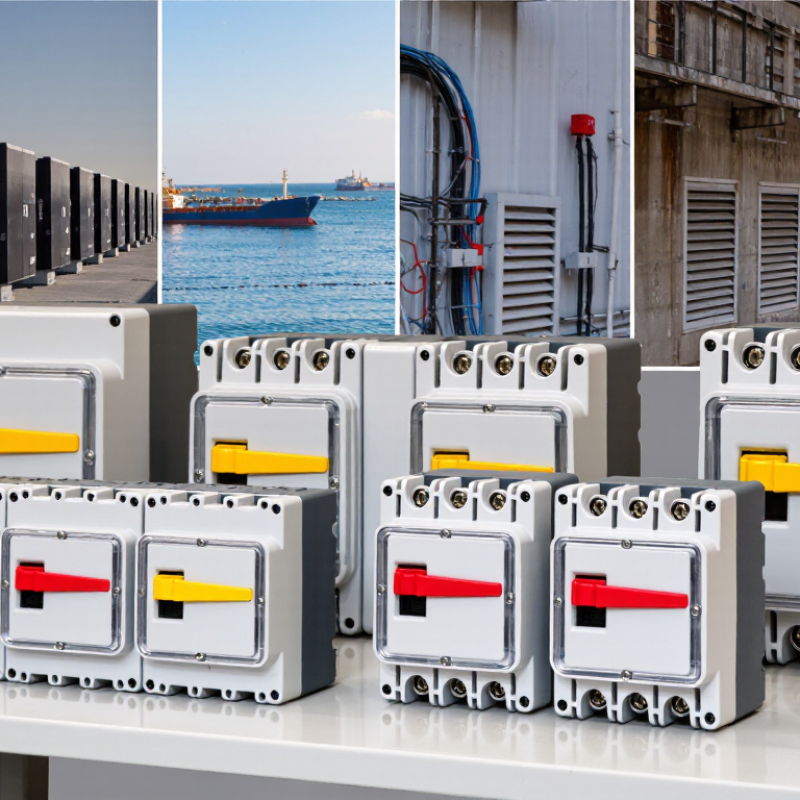
| Outdoor MCB in a Weatherproof Enclosure | 230/400 V AC | Typically 0.5–125 A | Typically 4.5–15 kA, depending on the model and installation system | Enclosure required
Use a UV-resistant, sealed enclosure, commonly IP54–IP65. | Outdoor lighting, small pumps, control panels, residential auxiliary circuits and small commercial loads | Compact, economical, easy to install and suitable for branch-circuit protection | Confirm ambient-temperature derating, moisture resistance, short-circuit rating, pole configuration and compatibility with the enclosure | IEC 60898-1; IEC 60529 for enclosure ingress protection |
| Outdoor MCCB | Up to approximately 1,000 V AC | Typically 16–1,600 A | Typically 18–100 kA at low voltage, depending on frame size and voltage | Enclosure required
Suitable for outdoor switchboards with corrosion, UV and condensation protection. | Industrial feeders, photovoltaic combiner systems, motor protection, generators and commercial distribution | Adjustable protection, higher fault ratings and better selectivity than most MCBs | Check trip-unit type, interrupting rating at the operating voltage, thermal derating, coordination and enclosure ventilation | IEC 60947-2; IEC 60529 for enclosure ingress protection |
| Outdoor ACB | Up to approximately 1,000 V AC | Typically 630–6,300 A | Typically 42–150 kA at low voltage, depending on the rating and test voltage | Outdoor switchgear
Normally installed inside a weatherproof, ventilated switchboard or kiosk. | Main incoming protection, utility substations, large industrial plants, data centers and generator paralleling systems | High continuous-current capacity, advanced protection, measurement and communication options | Consider arc-flash protection, draw-out or fixed construction, short-time withstand rating, maintenance access and climate control | IEC 60947-2; IEC 61439 for low-voltage assemblies |
| Outdoor Vacuum Circuit Breaker | Typically 3.6–40.5 kV | Typically 630–3,150 A | Common short-circuit interruption ratings are approximately 16–40 kA at medium voltage | Purpose-built outdoor models
Usually supplied in sealed or weather-resistant pole-mounted or ground-mounted assemblies. | Medium-voltage distribution feeders, substations, transformers, motors and renewable-energy collection systems | No SF₆ gas, low contact wear, long mechanical life and good performance for frequent operation | Verify insulation level, altitude correction, operating mechanism, anti-condensation heating, phase spacing and local wildlife protection | IEC 62271-100; IEC 62271-1; IEC 60529 where an enclosure rating applies |
| Automatic Circuit Recloser | Typically 11–38 kV | Typically 200–1,200 A | Common fault-interruption ratings are approximately 8–25 kA, depending on voltage and design | Designed for outdoor use
Mounted on poles or compact substation structures with weather-resistant controls. | Overhead distribution feeders, rural networks, agricultural areas, storm-prone circuits and utility automation | Automatically restores service after temporary faults and reduces outage duration | Check trip and reclose sequences, minimum operating temperature, control-power supply, communication protocol and coordination with fuses and upstream protection | IEC 62271-111; IEEE C37.60 |
| Outdoor SF₆ Circuit Breaker | Typically 72.5–800 kV | Typically 1,250–4,000 A | Common short-circuit ratings are approximately 31.5–63 kA for high-voltage applications | Purpose-built outdoor model
Installed in high-voltage substations with sealed gas compartments and monitoring systems. | Transmission substations, high-voltage lines, transformers and grid interconnection points | High dielectric strength, compact substation layout and reliable interruption at high voltage | Evaluate gas-leak monitoring, SF₆ handling requirements, environmental regulations, seismic rating, service support and end-of-life gas recovery | IEC 62271-100; IEC 62271-1; IEC 62271-203 for gas-insulated equipment where applicable |
| Outdoor Minimum-Oil Circuit Breaker | Historically approximately 3.6–145 kV | Commonly 400–3,000 A | Varies widely; many legacy units were rated approximately 12.5–40 kA | Legacy technology
Requires a suitable oil containment and fire-safety arrangement. | Older substations and replacement-in-kind projects where existing infrastructure is retained | Established operating principle and compatibility with some legacy installations | Check oil condition, fire risk, environmental containment, spare parts availability and whether a vacuum replacement is more practical | Applicable historical editions of IEC 62271-100 and local utility specifications |
| Outdoor DC Circuit Breaker | Typically 250–1,500 V DC | Typically 10–1,600 A | Common ratings range from approximately 5–100 kA DC, depending on voltage, polarity and circuit time constant | Application-specific
Requires a weatherproof enclosure and a breaker specifically tested for DC interruption. | Battery energy storage, solar photovoltaic systems, electric-vehicle infrastructure, telecom power and industrial DC networks | Designed to interrupt DC current without relying on AC current zero crossings | Confirm DC voltage per pole, polarity, series-pole arrangement, battery fault current, isolation requirements and arc-energy performance | IEC 60947-2; IEC 60947-3 where switching and isolation functions apply; IEC 60529 for enclosures |



 Close
Close