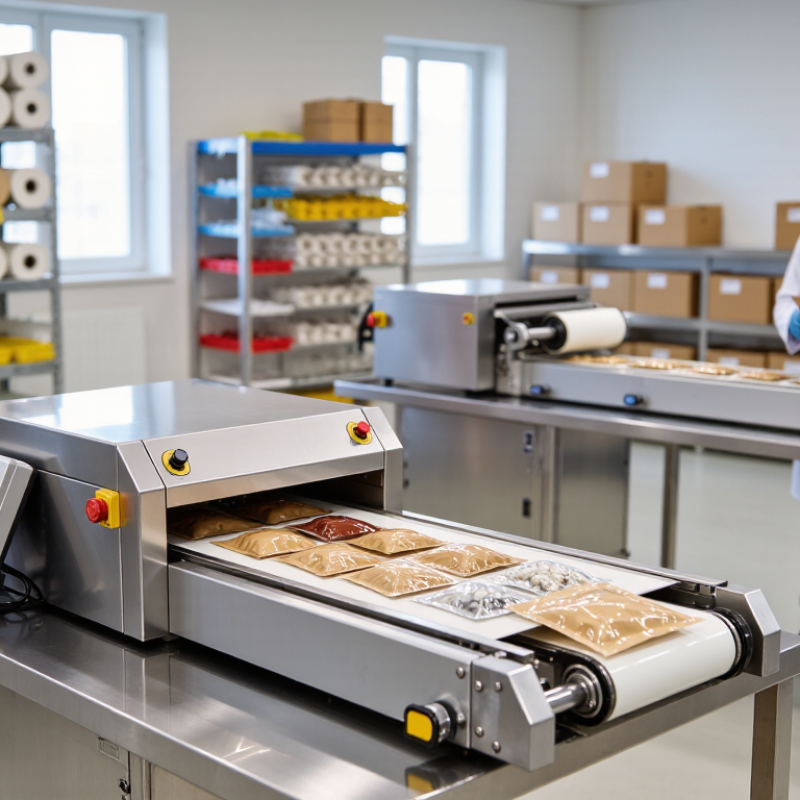
| Impulse Heat Sealer | Heat-sealable plastic pouches and bags, including suitable polyethylene and laminated films | Operator-dependent; commonly suited to low-volume or intermittent work | A heated bar seals the material when the operator activates the machine; the bar cools between sealing cycles | Small food businesses, sample packing, and production with frequent bag-size changes | Check bag width, seal width, film compatibility, sealing time, and whether a cutter or foot pedal is needed |
| Continuous Band Sealer | Preformed heat-sealable bags and pouches | Often adjustable up to approximately 12 m/min, depending on the model and material | Conveyor belts move bags through heated sealing wheels; some models also print a date or batch code | Regular, medium-volume packing where bags can be fed continuously | Confirm bag thickness, opening width, conveyor load limit, seal orientation, speed control, and coding requirements |
| Chamber Vacuum Sealer | Vacuum-compatible pouches containing meat, cheese, seafood, or other suitable foods | Cycle-based; cycle time depends on chamber size, vacuum level, and product | The pouch is placed inside the chamber; air is removed from the chamber and pouch before the pouch is heat-sealed | Food processors seeking vacuum packaging, especially for liquids or moist products that are difficult to seal with external vacuum machines | Check usable chamber dimensions, pump capacity, seal-bar length, cycle time, and pouch material; vacuum packaging does not replace food-safety controls |
| External Vacuum Sealer | Embossed or channel-textured vacuum pouches compatible with the machine | Cycle-based and generally suited to light-duty or small-scale packing | The machine draws air through the open end of the pouch, then heat-seals it | Home-scale, farm, or small-business use with limited daily volume and mostly solid products | Check pouch type, maximum bag width, duty cycle, pump design, and suitability for moist foods; smooth chamber pouches may not work |
| Tray Sealer | Preformed food trays with a compatible lidding film | Manual and semi-automatic models are cycle-based; output depends on cavities, operator handling, and cycle time | A heated die bonds lidding film to the tray flange; some systems can cut the film and modify the tray atmosphere | Prepared meals, fresh foods, and portion-controlled products sold in trays | Match tray dimensions and flange, film type, cavity layout, sealing temperature, and whether vacuum or gas flushing is required |
| Induction Sealer | Compatible containers fitted with a foil induction liner, commonly in capped bottles or jars | Depends on whether the unit is handheld, conveyor-based, and integrated with the filling line | Electromagnetic energy heats a foil liner, bonding it to the container opening | Products needing a tamper-evident inner seal on compatible containers | Verify container and liner compatibility, cap fit, line speed, seal inspection method, and applicable food-contact requirements |



 Close
Close